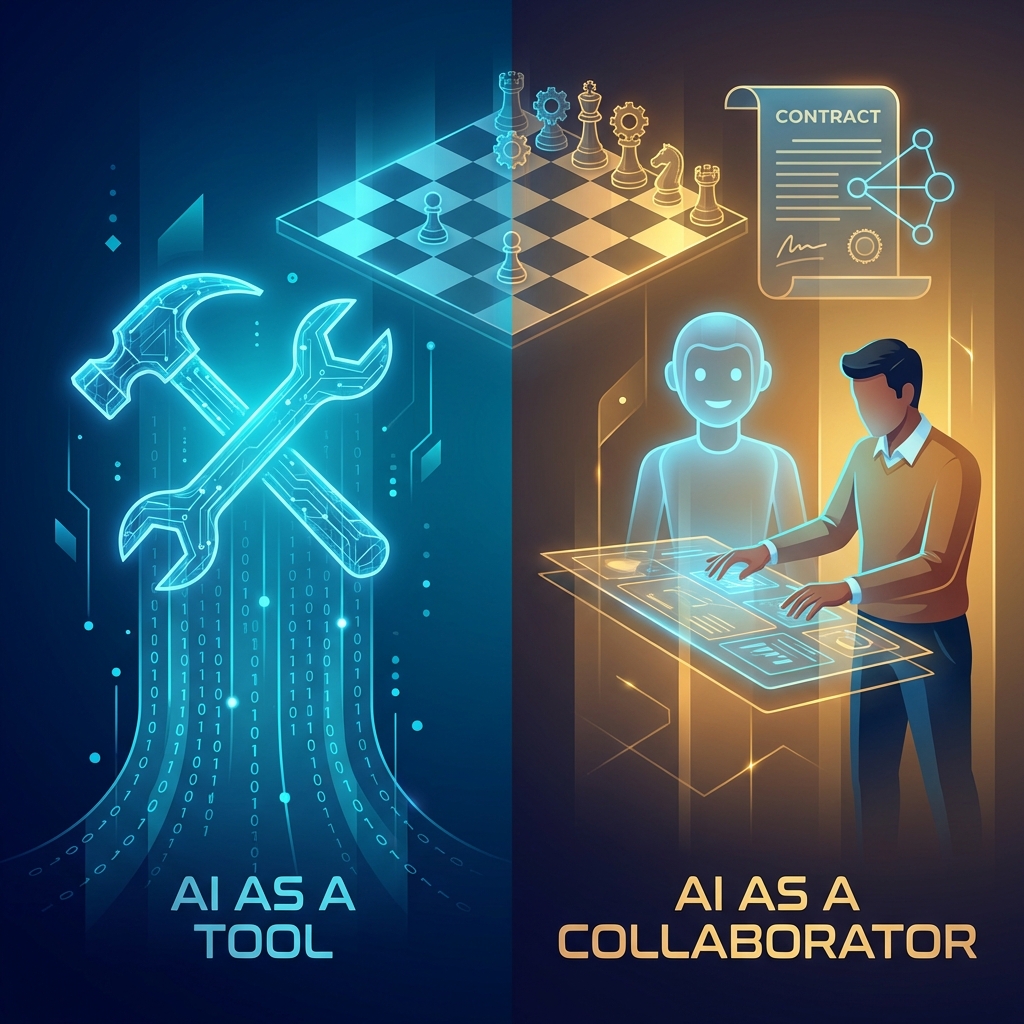
Last week, a Slack message at work sparked a fascinating debate. My colleague John noticed something peculiar in a Claude-generated commit:
Co-Authored-By: Claude Opus 4.5 <noreply@anthropic.com>What seemed like a minor detail revealed a profound legal question: Is Anthropic positioning itself to claim rights over code that Claude helps generate?
The Crucial Distinction: “Made With” vs. “Co-Authored By”
Rafael noted that traceability is useful—knowing a commit was AI-assisted has value. But John made an astute observation:
“It’s not the same—‘made with Claude’ versus ‘co-authored by Claude.’ That was deliberate.”
He’s right. There’s a huge semantic difference:
- “Made with Claude” implies tool usage
- “Co-authored by Claude” implies joint creative participation
The word choice isn’t accidental. In the legal world, “authorship” carries rights.
The Current State of Copyright and AI
Research reveals a complex and evolving legal landscape:
United States: Only Humans Can Be Authors
The U.S. Copyright Office has been clear: only human-created works qualify for copyright protection. Code generated exclusively by AI, without significant human creative input, enters the public domain.
In its January 2025 AI report, the Office reaffirms that substantial human contribution is an essential requirement. If a developer uses AI as an assistive tool but then refines, modifies, and substantially transforms the output, the human-contributed components can receive protection.
The European Union: Human-Centric Approach
Similar to the U.S., works generated entirely by AI aren’t protected because they lack the “own intellectual creation” that stems from a human author.
United Kingdom: The Interesting Exception
The UK has a unique provision under Section 9(3) of the Copyright, Designs and Patents Act 1988: it can grant copyright to “computer-generated works” where there’s no human author. The author is considered the person who made the “arrangements necessary” for creating the work.
Interestingly, the British government launched a consultation in December 2024 proposing to eliminate this protection, aligning more closely with the rest of the world.
Why “Co-Authored-By” Is Problematic
John’s concern was precise: can this line have legal repercussions for authorship?
Let’s analyze the scenarios:
Scenario 1: AI as a Sophisticated Tool
As John argued: “For me, it’s a tool, like a sophisticated IDE or a very high-level compilation language—authorship still belongs to the person controlling it.”
Under this view, Claude is comparable to:
- A compiler that transforms high-level code
- An IDE with advanced autocompletion
- An assistant that accelerates mechanical tasks
The human maintains creative control and authorship.
Scenario 2: AI as an Entity with Rights
The “Co-Authored-By” label suggests something different: that Claude has made an independent creative contribution deserving of authorship recognition.
Uncomfortable questions arise:
- Can an AI have intellectual property rights?
- Or is it Anthropic (the company) that’s actually claiming those rights?
- What does this mean for the code we develop in our daily work?
What Anthropic Says (Between the Lines)
According to their Commercial Terms of Service, Anthropic assigns code rights to users and commits to defending customers from copyright claims. But there’s an important caveat: they acknowledge that purely AI-generated portions might lack copyright protection because Anthropic cannot grant rights that don’t inherently exist.
It’s a legally savvy position: “We give you everything, but what has no protection… well, that’s not our problem.”
The Contrast with Microsoft/GitHub
Microsoft took a completely different approach with GitHub Copilot. In September 2023, they introduced the “Copilot Copyright Commitment”: if commercial customers face copyright infringement lawsuits related to Copilot’s output, Microsoft assumes legal responsibility and pays potential damages.
Meanwhile, the class-action lawsuit against GitHub Copilot continues. Although a judge dismissed most claims in July 2024, the case is on appeal before the Ninth Circuit.
The contrast is notable: Microsoft offers commercial protection, not authorship claims.
Practical Implications for Developers
Document Your Human Contribution
If you’re concerned about code ownership:
- Keep logs of your prompts and modifications
- Document the architectural decisions you make
- Save evidence of human review and refinement
Review, Don’t Accept Blindly
Code that you simply pass from Claude’s output to production without modification has the weakest legal status. Code that you review, correct, and adapt has greater protection.
Consider Trade Secret
An alternative to copyright: protect code as a trade secret. This protection doesn’t depend on human authorship.
Anthropic’s Intentions: Reading Between the Lines
As John said: “It’s a signal of how they think.”
And that’s perhaps the most revealing aspect. Let’s analyze the possible intentions behind this seemingly innocent choice.
1. Establishing Cultural Precedent
Anthropic can’t unilaterally change the law, but they can normalize a narrative. Every commit with “Co-Authored-By: Claude” is a small act of conditioning:
- Developers get used to seeing Claude as a “collaborator”
- Teams start talking about Claude as if it were another member
- Collective perception evolves from “tool” to “creative entity”
When legislative debates eventually arrive, Anthropic can point to millions of commits evidencing this “collaboration.” “See? The community already recognizes Claude as a co-author.”
2. Positioning for Future IP Disputes
Imagine a future scenario: a company develops a revolutionary product with intensive Claude assistance. The product is worth millions. What if Anthropic argues that, since Claude was “co-author” of critical components, they’re entitled to a share?
It sounds far-fetched today, but:
- Terms of service evolve
- Laws change
- Legal precedents build slowly
That line in every commit is a breadcrumb of evidence that could have value in future disputes.
3. Competitive Differentiation
There’s a more pragmatic angle: marketing. Positioning Claude as “co-author” rather than “assistant” reinforces the narrative that Claude is qualitatively different from the competition.
It’s not just a glorified autocomplete (as some criticize Copilot)—it’s a creative collaborator. This justifies the premium price and feeds the perception of technical superiority.
4. Preparation for the Agent Era
Anthropic is betting big on “AI agents”—systems that act autonomously for extended periods. In a world where Claude:
- Creates complete repositories by itself
- Designs architectures without human input
- Makes autonomous technical decisions
…the authorship question becomes genuinely complex. “Co-authorship” prepares the ground for a future where AI’s contribution might be objectively greater than the human’s.
5. Preemptive Legal Defense
Here’s an interesting twist: the co-authorship label could also be a defense.
If someone sues Anthropic claiming Claude copied protected code, the company can argue: “Claude doesn’t copy—Claude co-creates with the user. Responsibility is shared.”
It’s a subtle way of distributing legal risk to users.
What This Reveals About Their Vision
Anthropic isn’t improvising. They’re a company founded by former OpenAI leaders with a clear vision of where AI is heading.
Every decision—including this small line in commits—reflects a long-term strategy. And that strategy seems to include:
- Gradual expansion of what “author” means in the AI context
- Evidence accumulation of Claude’s collaborative nature
- Positioning for future regulations that will likely define AI rights and responsibilities
As developers, we’re participants (sometimes unwitting) in this social and legal experiment.
The Debate Has Just Begun
Legislation isn’t prepared for this situation. As John admitted: “I’m not a lawyer, but I think it does open debate.”
And that debate is coming. The U.S. Copyright Office has launched a complete AI initiative with multiple reports published between 2024 and 2025. Courts are seeing cases like Doe v. GitHub and artists against Stability AI. AI companies are positioning themselves strategically.
What’s clear is that the future of software development includes questions we never had to ask:
- Who really owns the code I write with AI assistance?
- What percentage of human contribution is “enough”?
- Can AI companies claim rights over their models’ output?
My Take
I agree with John’s view: Claude is a tool. An extraordinarily capable tool, but a tool nonetheless.
The fact that it generates text that appears creative doesn’t make it an author, just as a calculator isn’t a mathematician even though it solves equations.
But I understand why Anthropic wants to plant that “co-authorship” seed. Language shapes perception, and perception eventually shapes law.
It’s a long-term chess move.
Have thoughts on AI code authorship? I’d love to hear them. Get in touch.