Coding Agents and Teamwork: Social Skills, or Structure?
In this article
A complete study on a 19-task slice of CooperBench’s 652. Every condition ran to completion, the headline cells have three seeds, and I audited the eval harness itself — all on a subset I could run cleanly across two model tiers. The ceiling is coverage, not confidence: within this slice the pattern replicates; whether it holds across the full benchmark is the open question.
A recent Stanford benchmark, CooperBench (“Why Coding Agents Cannot be Your Teammates Yet”), reports a striking result: when you pair up two strong coding agents to split a task, their success rate roughly halves versus a single agent doing the same total work. They call it the curse of coordination, and their reading is that the missing ingredient is social intelligence — agents don’t use language for coordination reliably, so, they argue, this needs to be trained, not prompted away.
It’s a careful paper, and I want to be fair to it: they deliberately run agents with almost no scaffolding, precisely to measure intrinsic coordination ability. That’s a legitimate scientific choice. But it left me with an engineering question they explicitly set aside:
Human teams don’t coordinate well with zero process either. We don’t fix a team that keeps stepping on each other with therapy — we use structure: code ownership, interface contracts, sequential PRs, a reviewer who integrates. So how much of the “coordination gap” is really about social skills, and how much is just the absence of structure the agents were never given?
The setup
I started from CooperBench’s own benchmark (it’s open source) and reproduced the baseline: two agents, each assigned one feature of a task, working in separate containers but connected by a message channel they can use to coordinate at any time (the benchmark gives them this from the start), with their patches merged afterwards. That channel matters for everything below: the agents can always talk — the open question is whether talking is enough. Then I added a ladder of coordination structures, ordered from “advisory” (the agent can ignore it) to “enforced” (the scaffold guarantees it):
- Handshake (C1): agents must exchange a plan before the scaffold lets them edit code. (Analogy: a design review before coding.)
- File ownership (C2): each file is owned by one agent; edits to another agent’s file are reverted. (Analogy: CODEOWNERS.)
- Line-range ownership (C2b): finer version — both may edit the same file, but only in disjoint regions. (Analogy: not stepping on each other’s functions.)
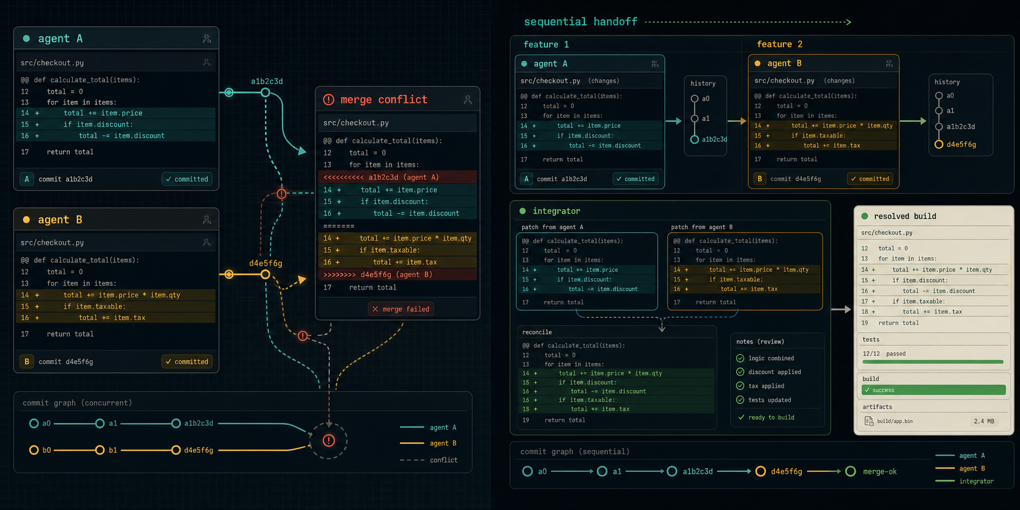
- Sequential pipeline (C3): agent A implements feature 1 and commits; agent B starts from A’s code and adds feature 2. No concurrency. (Analogy: small, sequential PRs on trunk.)
- Integrator (C4): A and B work independently; a third agent reconciles both patches. (Analogy: an integration engineer / PR reviewer.)
The point of the ladder is to separate “did they talk?” from “did the process stop them from colliding?” — and to find the minimum structure that helps.
Results
Caveats first, because they matter: these are 19 task-pairs across 5 repositories — a subset I could run cleanly — not the full benchmark. But I ran the whole ladder on two capability tiers (a mid-tier gpt-5.4-mini and a stronger gpt-5.4), and the four headline conditions were run three times each so I can show a range instead of a single noisy number.
| condition | mini | gpt-5.4 |
|---|---|---|
| solo (one agent, both features) | 14% [11–16] | 30% [21–37] |
| coop (two agents, free-form) | 7% [0–11] | 7% [0–16] |
| coop + fair conflict resolution* | 7% [0–11] | 9% [0–16] |
| team — the paper’s own (lead + member, shared task list)† | 0% | 0% |
| sequential (C3) | 26% [21–37] | 35% [32–37] |
| integrator (C4) | 23% [21–26] | 33% [26–42] |
| file ownership (C2) | 0% [0–0] | 14% [11–16] |
| handshake (C1)† | 0% | 0% |
| line ownership (C2b)† | 0% | 0% |
Headline cells and C2 are mean [min–max] over three seeds; †team, C1 and C2b are a single run each — I only replicated the conditions with any signal to defend (all three sat at 0% for the weak model and never beat plain coop, so a second seed wasn’t going to change the story). *The paper’s eval auto-resolves trivial merge conflicts with a small model before declaring failure; the open-source release omits that step. I added an equivalent (if anything stronger) resolver and re-scored the concurrent conditions — details in “Under the hood”.
Four things stand out:
-
The coordination gap reproduces — and it’s wider for the stronger model. Two agents working concurrently (coop) score below one agent doing the whole task (solo): 14%→7% for mini, 30%→7% for gpt-5.4. Pooled across tiers and seeds the drop is solid (paired McNemar p=0.002); split out, it’s clearly significant for the strong model (p=0.002) and not for the weak one (p=0.39) — simply because mini’s solo baseline is already low, so there’s less to lose. The curse of coordination bites hardest where a single agent was actually competent.
-
Two structures recover it — and sequencing does more than recover. The sequential pipeline (C3) and the integrator (C4) both beat coop decisively at both tiers (p<0.0001). They share a mechanism: one agent ends up owning the final integrated state — B builds directly on A’s finished work, or a reviewer reconciles both patches in a single workspace. But the two aren’t equivalent. Sequencing doesn’t just claw back to solo — for the weak model it beats solo (mini 26% vs 14%, ahead in all three seeds, p=0.039), while merely tying it for the strong one (large 35% vs 30%, p=0.45). The integrator recovers over coop but never significantly beats solo (p=0.23). Read plainly: decomposing the task so agent B faces “add feature 2 to a codebase that already has feature 1” is a smaller problem than “build both at once” — and a smaller problem helps most whoever was struggling with the big one.
-
So structure interacts with capability — in both directions. That’s the genuinely interesting part, and it cuts two ways. Sequencing helps the weak model more (it lifts mini above its own solo baseline; it only matches solo for the strong one). Enforced file ownership (C2) is the mirror image — across three seeds it recovered nothing for the weak model (0% in all three) but reached a stable 14% [11–16] for the strong one. Two opposite-signed interactions: lightening the cognitive load (sequencing) rescues the weaker model, while a rule it must actively exploit (ownership) only pays off for the stronger one. One honest deflation, though: C2’s 14% is not significantly better than coop once coop’s merges are scored fairly (14% vs 9%, McNemar p=0.73 across the three seeds), and it stays far below solo (0-of-13 tasks where they differ, p<0.001). So the fence’s value over a decent merge pipeline is real-looking but statistically a wash — the capability interaction shows up in who can use the rule at all, not in a scoreboard win.
-
Forcing communication does nothing — because they already communicate. The handshake gate (C1) never even fired: agents already message each other before touching code (first message on turn 2, first edit on turn 6). Making them talk more changed nothing, at either tier. This echoes CooperBench’s own “communication doesn’t help” result — and suggests the problem isn’t whether they exchange information, but what they do with it.
A smaller, slightly uncomfortable note: finer line-range ownership (C2b) did worse than coarse file ownership (C2, 16%) for the strong model. I first suspected an artifact of my v1 enforcement, which reverted the whole file on any overlap — so I built a v2 that reverts only the violating hunks and re-ran both tiers: 0% at both. The binding constraint isn’t revert granularity. It’s that CooperBench features intentionally overlap on shared lines (the same import list, the same function signature), so any exclusive line ownership starves whichever agent arrives second.
One logged run shows the failure in miniature. Agent 1, blocked by the territory guard, escalates exactly the way a person would — announces, asks, and finally delegates — while agent 2 says its piece once and then goes quiet:
I'm going to touch _other.py and __init__.py for an IsMac validator. Are you touching either of those? …so I can keep the patch merge-friendly?
I'm about to add an IsEmail validator. I expect to touch _other.py and __init__.py too. …can we coordinate to avoid conflicts?
The guard reverted my first attempt — claimed regions. Can you avoid the import block and __all__, and the top of _other.py?
The guard is blocking me from the import/export regions. Could you add the IsMac re-export there, since you own that region?
I checked the plumbing on both sides: all of agent 1’s messages landed in agent 2’s context with turns to spare, and agent 2’s outbound channel demonstrably worked — it sent the first message of the whole thread. It read the requests, even planned to coordinate in its own reasoning, and then never replied, never added the one-line export it owned, and closed out its task. The bottleneck isn’t the communication channel; it’s follow-through — precisely the commitment failure CooperBench’s taxonomy describes, reproduced here with the channel verified blameless.
Under the hood: collaboration dies at the merge
Digging into how each condition fails changes the picture more than the pass rates do.
Free-form coop fails at the merge, not at the code. 14–15 of 19 coop failures (both tiers) are outright merge conflicts — the two agents’ patches can’t even be combined. And here’s the striking part: enforced ownership drives merge conflicts to zero — 0 of 19 for both C2 and C2b, at both tiers. The failure then moves downstream: patches combine cleanly but the integrated code doesn’t pass both suites.
But is dying at a merge conflict too cheap a death? (Isn’t resolving conflicts what PR review is for?) It’s a fair objection — and it turned out to be aimed at a real gap: the paper’s own eval resolves trivial conflicts with a small trained model before declaring failure, but the open-source release omits that step, so my first table scored every conflict as an instant fail. I checked it both ways. First, I triaged all 29 conflicted pairs by hand: roughly half the conflicts aren’t real logic collisions — two agents adding a different import, or a different keyword argument, to the same line; git flags it, the code wouldn’t care. Then I added a trivial-conflict resolver (using a stronger model than the paper’s, so coop gets every benefit of the doubt) and re-scored the conflicted pairs across all three seeds. It rescued plenty of merges — but almost none of them became passes: fair-merge coop lands at 7% for mini (unchanged) and 9% for gpt-5.4 (up from 7%), a single extra task. The conflicts were mostly masking semantic failures further down: in one rescued pair, one feature passed 71/71 tests and the other failed a genuinely broken assertion the conflict had been hiding.
So the causal chain reads:
unstructured concurrency → ~75% merge conflicts → the syntactic layer can be fixed two ways — prevention (enforced territory: zero conflicts) or cure (a trivial-conflict resolver) → what’s left is a semantic integration problem → and neither fences nor resolvers fix that. Sequencing or an integrator do.
This rhymes with CooperBench’s own observation that communication reduces conflicts without improving success — the syntactic layer is simply not where the task is won.
The “0%” rows hide half-done work. Scoring requires both features to pass. Count partial success (at least one feature working) and the weak model’s picture shifts: free-form coop lands only a handful of single-feature passes, while enforced ownership roughly doubles them (mini reaches 5/19 under line-range enforcement). Enforcement turns total collapse into “half the job done” more often — it’s just not enough to clear the both-features bar.
The paper’s own structured team is the worst of all — and that’s the point. CooperBench ships a richer coordination mode than plain coop: a lead and a member with a shared task list, the lead responsible for integrating both features and shipping one patch. It scored 0% at both tiers — below even free-form coop. The partial credit is the tell: the lead passes its own feature in 7/19 (weak) and 11/19 (strong) pairs, and never both. It does its half and drops the partner’s — the same follow-through failure as coop, except the richer protocol adds a manual hand-off step (the lead pulls the member’s patch from a shared workspace and stitches it in) that turns out more fragile than letting the merge tool do it. More coordination structure, more places to fumble the hand-off. (A rigor note, since a flat 0% deserves suspicion: the open-source eval routed team like coop and merged both patches — double-applying the member’s work, which is already inside the lead’s patch. I fixed it to score the lead’s shipped artifact instead; the number didn’t move, but now it’s measuring the right thing.)
Both tiers hit the fence equally often; only one recovers. The enforcement hook fired a similar number of times for both models (≈18–29 violations per run). The strong model isn’t “tidier” — it violates territory just as much. The difference is what happens after the revert: the strong model re-plans and routes around it; the weak one keeps banging. All three of the strong model’s C2 passes had enforcement events — the mechanism was active in every one of them, they weren’t conflict-free freebies.
Statistics, honestly. The four headline conditions and C2 have three seeds each; C1 and C2b are single runs (both flat at 0% for the weak model). Paired McNemar tests (matched per task and seed) give: the coordination gap solid pooled (p=0.002) and clearly significant for the strong model alone (p=0.002); sequencing and the integrator each beat coop overwhelmingly (p<0.0001); sequencing beats solo pooled (p=0.021) and for the weak model alone (p=0.039, ahead in all three seeds), while only tying solo for the strong one (p=0.45); the integrator recovers but never significantly beats solo (p=0.23). One honest caveat on the method: pooling discordant pairs across seeds treats each (task, seed) as independent, which mildly overstates significance — so I lean on the per-seed direction (mini seq > solo in 3/3 seeds) as much as on the p-value. With three seeds on a 19-task subset these are still directional; I’d want a larger repeated run before hardening any single number.
Teamwork has a price tag. For the strong model, per run: solo cost ~$3.60; sequential ~$7.10 and the integrator ~$9.73. Sequencing roughly doubles the bill to modestly beat solo; the integrator nearly triples it to match. On small, coupled tasks, if you must collaborate, sequence; if you can avoid it, one capable agent is the cheapest strong option.
Can you stack the fixes?
If enforced territory kills syntactic conflicts and an integrator owns the merge, surely combining them beats either alone? I tried three combinations: territory + integrator, sequencing + reviewer, and handshake + territory. Short answer: none robustly beats its own components.
The instructive one is territory + integrator. At one seed it looked like the star of the whole experiment — 42% for the strong model, seemingly ahead of the integrator alone. Then I ran two more seeds and it collapsed to 33% [21–42]: the 42% was a lucky draw, and paired against the plain integrator across all three seeds it comes out at p=1.0 — indistinguishable. The replicates existed precisely to catch that kind of over-claim, and they did.
But a cleaner measurement rescues something real. For each pair I re-scored the tree without the extra stage, on the very same two agent patches — so the only variable is the extra stage itself, no run-to-run noise. The integrator, measured this way, rescued 8 pairs and broke 0; the reviewer (on top of a sequential pipeline) rescued 3 and broke 3, a net zero. So the integrator’s contribution is genuine and one-directional — it only ever helps. The reason territory + integrator still doesn’t win on the scoreboard: the territory-constrained development phase hands the integrator no better raw material than plain independent development does, so a real but modest boost starts from equally noisy inputs and washes out across seeds. The reviewer nets zero for a simpler reason — a sequential pipeline already integrated the tree, so there’s nothing left to reconcile, only code to accidentally break.
The lesson isn’t “structure doesn’t stack.” It’s narrower: stacking composes only when an earlier stage improves the inputs to a later one. Sequencing→review fails that test (nothing to improve); territory→integrate fails it too (territory doesn’t make better patches, just non-overlapping ones). The one lever that keeps working is the same one from the single conditions — one agent owning the integration — and doubling down on it by combination didn’t buy more.
What this does and doesn’t say
It does not say CooperBench is wrong — I reproduced their gap at both tiers. What it adds is the piece their setup deliberately left out: once you give agents structure, does the gap close? On this subset, partly — and which structure works depends on both the structure and the model.
The honest headline isn’t “structure beats social skills.” It’s narrower and, I think, more useful:
- The most reliable lever wasn’t communication or ownership — it was giving one agent ownership of the final integration: hand off sequentially, or appoint an integrator/reviewer to own the merge. Both recover solo-level performance at both tiers, and sequencing does best of all.
- The structure has to match the model. Sequencing — which shrinks the task rather than adding rules to obey — is the one intervention that lifts the weak model above its own solo score; concurrent collaboration otherwise stays dead for it no matter what you fix (fair merging, fences, handshakes all leave it flat). Enforced ownership, a rule the agent has to actively exploit, only paid off for the strong model. Below some capability threshold, handing an agent a coordination protocol is like handing a process manual to someone who can’t yet do the underlying job — but handing it a smaller job still helps.
So “they can’t be teammates yet” reads, from here, less like they lack social intelligence and more like they were dropped into an unstructured free-for-all no sane engineering team would run — and the fix that generalizes is process (decompose + sequence, or appoint an integrator), not exhortations to communicate.
Are humans actually better at this?
It’s tempting to read the paper’s framing as “agents lack the social intelligence humans have.” But look at the three failure modes I found and ask honestly whether we are immune to them:
- Concurrent edits collide at the merge. Two humans editing the same file in parallel produce merge conflicts too — constantly. We didn’t solve that by getting more socially intelligent; we solved it with process: small PRs, code ownership, trunk-based development, “rebase before you push.”
- Follow-through fails even when the message arrives. The sharpest failure here was an agent that read a teammate’s request, wrote “I’ll need to coordinate with them,” and then simply didn’t. If you’ve ever watched a Slack request get a 👍 and then nothing, you know humans do this too. Our fix isn’t willpower — it’s tickets, assignees, standups, and “who owns this?” made explicit.
- What rescued the agents is what we already do. One agent owning the final integration — sequential handoff, or a designated integrator/reviewer — is just trunk-based development and the release-manager role. We didn’t invent those because we’re bad at talking; we invented them because unstructured concurrency doesn’t scale for anyone.
So the fair comparison isn’t “humans vs agents at coordination.” It’s “humans with decades of accumulated process vs agents dropped into a process vacuum.” Put a human team in the agents’ exact setup — no ticketing, no ownership, no review, just a chat channel and “go” — and it would step on itself too. The honest difference that remains: when process is missing, a good human improvises it (pings the right person, swivels their chair, calls a five-minute huddle); the agents, handed the very same channel, mostly didn’t. That gap — improvising coordination when none was imposed — is real, and it may be exactly what “social intelligence” is pointing at. But it’s a smaller, more specific gap than “they can’t be teammates,” and the practical lesson cuts the same way for both species: don’t rely on anyone, silicon or carbon, to invent process in the moment — give them the process.
Caveats and what’s next
- 19 pairs, 5 repos. The headline conditions and C2 have three seeds (hence the ranges); C1 and C2b are single runs at 0%/near-0%, so those two are the softest numbers here.
- Passes concentrate in a few repos. Every pass, in every condition and tier, lands in two Python repos (plus one Pillow task); four of the nine tasks were solved by nothing, ever — including solo. The effectively discriminative set is closer to ~10 pairs than 19.
- The subset skews toward what I could run natively; broadening it is the obvious next step.
- The C2b number survived a v2 with per-hunk reverts (0% at both tiers on a re-run) — it is not a revert-granularity artifact.
- A caution from building this: two conditions initially scored a false 0% due to eval-composition bugs (a stacked patch evaluated against the wrong base). I then ran two independent adversarial code audits over all five condition implementations and the eval routing; the published numbers survived, and the audit is what surfaced the missing conflict resolver behind the fair-merge row above. In agent harnesses, the scoring plumbing deserves as much testing as the conditions themselves.
- One thing I couldn’t test here: restart-vs-iterate. There’s a related question — when an attempt is going badly, does a capable agent throw it away and start fresh, or keep patching a sinking ship? I mined all 1,806 trajectories and found zero voluntary restarts — but that’s an artifact of this setup, not a finding: CooperBench agents make a single pass and never see the test results, so they’re never shown the failure signal that would prompt a restart in the first place. The closest thing I can see is adaptation after an imposed restart (when territory enforcement reverts an edit) — a cousin of the real question. Measuring restart-vs-iterate properly needs a different harness — visible tests, several iterations, an explicit restart affordance — and that’s the next experiment.
All five conditions, the combos, the LLM conflict resolver, and the eval fixes are implemented on top of the open CooperBench harness — the full fork is public at github.com/JaviMaligno/CooperBench (branch experiment/structural-conditions), so you can reproduce or poke holes in any of this.
Responding to CooperBench (Khatua, Zhu, et al., 2026). The headline cells are three-seed means on a 19-task subset; broadening the task set is the next step.