Let the Loop Iterate: Restarting Only Pays If You Know What to Throw Away
In this article
A complete study: 3 seeds × 3 policies × 2 model tiers on a 29-feature slice, with the eval harness audited before trusting a single number. Same rigor protocol as the coordination article — this experiment is its direct sequel.
There’s a piece of agent folklore, crystallized by Andrej Karpathy as “let the loop restart”: when a coding agent’s attempt is going badly, don’t keep patching the sinking ship — throw the attempt away and let it start fresh. It has intuitive appeal. Anyone who has watched an agent dig itself deeper into a broken approach has felt it.
But is it true? In my previous experiment I couldn’t even test it: CooperBench agents make a single pass and never see their test results, so the failure signal that would prompt a restart never reaches them. I mined all 1,806 trajectories and found exactly zero voluntary restarts — an artifact of the setup, not a finding. Measuring restart-vs-iterate properly needed a different harness.
So I built one.
The setup
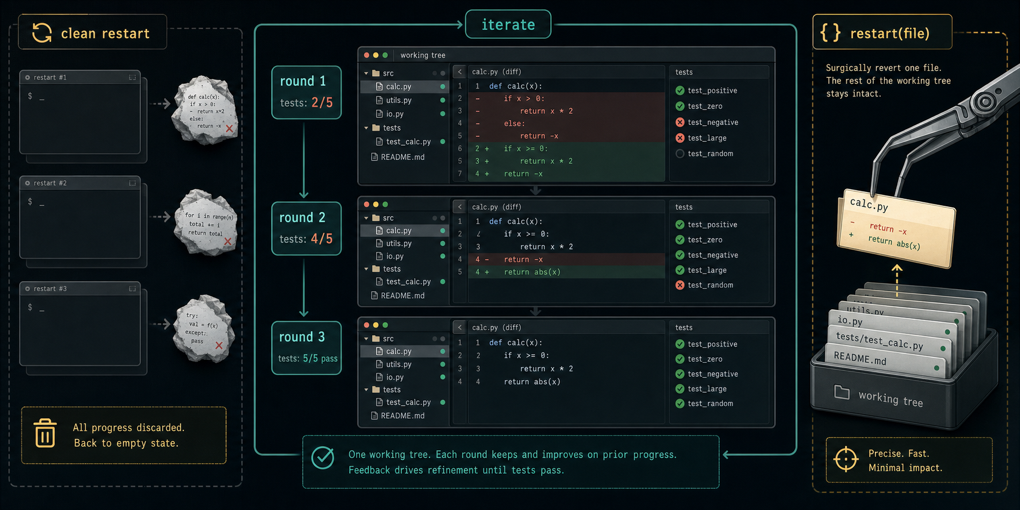
On top of the same CooperBench-derived stack (29 single-feature tasks across 5 real repositories, two model tiers: a mid-tier gpt-5.4-mini and a stronger gpt-5.4), I added the missing piece: a loop with a visible evaluator. The agent attempts the feature; the harness runs the feature’s test suite and shows the agent the results (pass/fail counts plus the failing tests’ output); then comes the next round — up to K = 4 rounds, stopping early on success.
Every policy gets the same K, the same per-round compute caps, and the same feedback format — so the only variable is what happens between rounds:
- ITERATE — the classic loop: code and context accumulate; the agent patches its own work with the test results in hand.
- RESTART-FRESH — the literal Karpathy reading: each round starts from a clean checkout with a fresh context. No memory of prior attempts. This is deliberately best-of-K sampling — that is the claim, tested at equal compute, not apologized for.
- RESTART-INFORMED — clean checkout, but the context carries a short summary of what failed, built by the harness from artifacts (never written by the failing agent itself). This separates the mechanism: if informed beats fresh, the lesson helps; if fresh matches informed, the contaminated context was the problem.
- AGENT-DECIDES — the interesting one: an iterate-style loop where the agent holds an explicit restart tool with scope —
restart(file | directory | all-my-work)— presented as a legitimate, cost-free option. It chooses when to discard and how much.
Results
Three seeds per headline cell; the table shows mean [min–max] over 29 features.
| policy | mini | gpt-5.4 |
|---|---|---|
| iterate (patch with feedback) | 74% [72–76] | 86% [79–90] |
| restart-fresh (clean best-of-K) | 63% [62–66] | 69% [69–69] |
| restart-informed (1 seed) | 69% | 79% |
| agent-decides (scoped restart tool) | 75% [69–79] | 91% [90–93] |
Four findings, in order of how well they survive the statistics:
-
Iterating on feedback beats clean restarting — decisively for the strong model. Paired McNemar across the three seeds: gpt-5.4 iterate wins 17–2 over restart-fresh (p=0.001); mini leans the same way (15–6, p=0.078). At equal compute, K attempts refining one trajectory with test feedback outperform K independent clean attempts. The literal let-the-loop-restart — restart as blind resampling — loses on this benchmark.
-
What hurts isn’t the contaminated context — it’s losing the working tree. Restart-informed (clean code, lesson retained) lands between fresh and iterate at both tiers. The harness-built lesson recovers part of the gap, but nothing beats keeping the actual code. At this horizon (K=4), the “poisoned context” the restart intuition worries about simply wasn’t the binding constraint.
-
Handing the agent the decision is the best cell in the table — and it never hurts. Agent-decides tops both tiers (91% for gpt-5.4, its best; 75% for mini). Against restart-fresh at the strong tier it wins 19–0 (p<0.001). Against pure iterate the edge is not significant (8–4, p=0.39) — so read it conservatively: the bulk of the value is in iterating; the restart option adds a plausible-but-unproven bonus and costs nothing.
-
The capability marker is restart style — though the causal story is subtler than “scalpel vs. wrecking ball.” This is the finding I’d keep if I could keep only one, and it’s the one a sharp reader (@alex_spinov, in the comments) pushed hardest — rightly. The raw pattern is real: across three seeds the strong model restarted rarely and surgically (7 restarts, 5 file-scoped, 3 of 4 restarted feature-runs solved), while the weak model restarted often and destructively (34 restarts, 23 of them
scope=all, only 1 of 14 restarted feature-runs solved). But restarts are self-selected — the agent reaches for one exactly where it’s already losing — so restarted features are a hard subset by construction. The honest test is the counterfactual: the same features and seeds under pureiterate, which the harness already ran. It separates the tiers cleanly:- Weak tier — the wrecking ball is a symptom, not the cause. Those same 14 features solve just 2/14 under iterate, nowhere near the 74% base. Broad restarts didn’t destroy winnable work; the agent razed everything because the feature was already lost. Restart is roughly neutral here (1/14 vs 2/14), not destructive.
- Strong tier — the scalpel genuinely rescues. Those same 4 features solve 0/4 under iterate; the scoped restart turned three of them into wins. Against the right baseline — the matched subset, not the 91% global rate — that’s a real causal gain, though at n=4 it’s directional (exact p≈0.25), not significant.
So the sharpened claim: knowing what to throw away is the metacognition, and it’s the strong tier’s scoped restart that actually pays — while the weak tier’s broad restart is the signature of an agent that has already lost, not the mechanism of its loss.
Under the hood
The pilot earned its keep. Before spending on the full grid, a 6-feature pilot caught three real composition bugs in my own harness — patches that the evaluator accepted but the next round couldn’t re-apply, and (the big one) iterate rounds being scored against a tree that was missing the earlier rounds’ work. That last one is the same bug class that produced a false 0% in the previous article. All three were fixed test-first and the contaminated pilot data was discarded and re-run. If you build agent loops: the round-to-round state composition is where the bodies are buried.
An adversarial audit gated the spend. As in the previous article, an independent reviewer agent audited the loop before Phase 1 — verdict FAIL, two integrity issues (a cost cap that could silently drop features from the denominators, and harness-error rounds masquerading as “no progress”), both fixed and re-audited to PASS before any headline run. Every round persists its patch, its test results, and the exact composed tree that was evaluated, so all curves are re-analyzable offline without re-spending.
Equal compute, honestly. Restart-fresh is best-of-K sampling and was treated as such — same rounds, same caps. Its failure mode is visible in the round curves: when fresh fails, it burns all four rounds without converging (its per-feature cost on failures ran 5–10× the successes). Iterate’s failure mode is the plateau — rounds without gaining a single test — which happened, but less often than the restart intuition predicts (about 1 in 5 unsolved runs at the strong tier).
Cost. The whole experiment — pilot, three policies × two tiers × three seeds, the decision phase, and all the debugging — came to about $102 of API spend. The per-solve cost differences between policies were small compared to the pass-rate differences; nothing in the money changes the ranking.
What this does and doesn’t say
It does not say Karpathy is wrong in general. It says: in the regime I measured — feature-sized tasks on existing codebases, four rounds, tests visible — restart-as-resampling loses to iteration, and the restart that does pay is scoped, informed, and rare. Regimes where I’d expect the balance to shift toward restarting: greenfield tasks (where “start over” genuinely means a blank page and first attempts anchor hard), much longer horizons (where context genuinely rots), and models below some competence floor (where every attempt is a fresh dice roll anyway — though note that even our weak tier did better iterating).
The echo with the coordination article is hard to miss. There, the lever that worked was structural (one agent owning the integration) and the strong model was the one that could exploit a rule. Here, the lever that works is keeping your work and reading the feedback, and the strong model is the one that can wield a scalpel. Both experiments land on the same shape: capability doesn’t just raise pass rates — it changes which process helps. Give a weak agent a powerful affordance (a coordination protocol, a restart button) and it flails with it; give it a smaller problem or a tighter loop and it improves. Give a strong agent the same affordance and it uses it the way you hoped.
If you run coding agents in practice, the actionable version is three lines:
- Default to iterate with visible tests — don’t restart-by-default, and don’t hide the feedback.
- If you add a restart affordance, expect only your stronger models to wield it well — on our data, the strong tier’s scoped reverts rescued features plain iteration lost (3/4 vs 0/4 on the same features), while the weak tier’s restarts merely marked work that was already sunk. Don’t count on forcing narrow scope to lift a weaker model’s pass rate.
- Watch the style of your agent’s discards. Frequent, broad restarts aren’t decisiveness; on our data they’re the signature of an agent that’s already lost — iteration fails those same features too.
Caveats and what’s next
- 29 features, 5 repos, K=4. Three seeds on the headline cells (informed has one). Small-N caveats apply as always; the iterate-beats-fresh result is the one with real statistical teeth (p=0.001), the agent-decides edge over iterate is directional only.
- Not greenfield. Feature-scoped restarts on an existing codebase cap how much “starting over” can even mean. The scope tool’s ceiling is low here by construction.
- One agent framework, one model family (GPT-5.4 tiers on Azure) — cross-family replication is the obvious next step.
- The decision prompt frames restarting as legitimate and cost-free; a different framing might shift restart rates (though it shouldn’t shift the payoff asymmetry between tiers, which is the core finding).
Everything is reproducible: the loop harness, all four policies, the metrics, and the per-round artifacts are public in github.com/JaviMaligno/CooperBench (branch experiment/restart-loop).
Prompted by Andrej Karpathy’s “let the loop restart” observation. Sequel to Coding Agents and Teamwork: Social Skills, or Structure?