The Riemann Hypothesis Has a Proof Nobody Has Read. Its Core Idea Fits in a Sentence

In this article
- What was proved, exactly
- It has been “proved” many times before
- A proof nobody has read
- The idea, in one sentence
- Where the square root comes from
- What it took underneath
- Who did what
- Is this a continuation of OpenAI’s October result?
- The other proof, the same afternoon
- Theorems that changed status overnight
- The same day, the other Millennium problem
- “Math is dead”
- What to take from it
On Friday 20 November, Levent Alpöge, a number theorist who works at Anthropic, posted a four-page note on his personal website. Its second paragraph begins: “I believe I have, working with Claude, discovered a proof of the Riemann Hypothesis.” The proof itself is not in the note. It is in a footnote: fourteen links to an archive of Lean code, the language in which a program can check a mathematical proof step by step.
The Riemann hypothesis is the best-known open problem in mathematics. It is 167 years old, it is one of the seven Millennium Prize problems, and it says, in one line, that the prime numbers are spread as evenly as they possibly could be. By the end of that Friday, people who had nothing to do with the author had compiled the archive, and the checkers had accepted it.
The coverage has been about the machine beating the mathematicians, and about a second, all-human proof that appeared the same afternoon. Both are real stories. This is the third time since September that I write one of these, after Navier–Stokes in September and the Exponential Time Hypothesis in October, and as with those, the parts I find most interesting do not fit in a headline: what exactly was proved, why this claim was not dismissed like all the earlier ones, what it means that nobody has read it, why the central idea is one you can explain at a blackboard, who did what, and which theorems changed status overnight.
What was proved, exactly
The archive proves five statements, and the first one is the Riemann hypothesis word for word as the Lean community had already written it down.
The primes thin out in a regular way: near a large number x, about one number in log x is prime, where log is the natural logarithm. Near one million, log x is about 13.8, so roughly one number in fourteen should be prime; among the thousand numbers that follow 1,000,000 the estimate gives 72 primes, and there are 75. In 1859 Bernhard Riemann showed that the fine detail of that pattern is controlled by a single function, the zeta function ζ(s), and specifically by the complex numbers s where it equals zero. Some of those zeros are uninteresting (the negative even integers). All the others lie in a vertical strip of the complex plane, between real part 0 and real part 1. The hypothesis is that they all sit exactly in the middle of it, on the line of real part 1/2.
Mathlib, the community library of mathematics formalized in Lean, already contained a definition called RiemannHypothesis. Nobody had proved it; the definition was there so that other results could say “assuming this”. The archive’s first theorem is a proof of exactly that definition, which matters more than it sounds: the statement was written by other people, before the proof existed, so the proof cannot have quietly proved something easier under the same name.
The other four statements go further. They say the same about a whole family of related functions, the Dirichlet L-functions. Loosely: ζ(s) is built by adding up 1/n^s over all whole numbers n, and a Dirichlet L-function is the same sum with each term multiplied by a label that depends only on the remainder of n when divided by some fixed number, for instance on its last digit. ζ is the case where every label is 1. The labels are what let you single out the primes in one arithmetic progression (those ending in 7, say), and each labelled sum has its own zeros controlling those primes. That is the Generalized Riemann Hypothesis for Dirichlet L-functions, for every modulus and every character.
The scope has an edge, and it is worth knowing where it is. “GRH” is used for several statements of increasing reach. What the checkers accepted concerns Dirichlet L-functions only. The versions for the zeta functions of number fields and for automorphic L-functions in general are not among the five theorems. Alpöge writes that he expects the method to reach further “with more time”; Andrew Sutherland’s verification page at MIT says plainly that those were not checked, because they are not there.
It has been “proved” many times before
Announced proofs of the Riemann hypothesis are a genre, and almost none of them is taken seriously for more than a day.
The oldest goes back to 1885, when Thomas Stieltjes wrote to Charles Hermite that he had proved a bound which would have implied the hypothesis. He never published a proof. A slightly sharper form of the same bound, the Mertens conjecture, was shown to be false a century later, in 1985. Louis de Branges, who did settle a famous open problem in the 1980s, the Bieberbach conjecture, has kept working on a proof of this one; in 2000 two other mathematicians showed that the condition his approach needs does not hold, and his attempts have not been widely accepted. And the preprint servers receive a steady supply of short papers titled some variant of “A proof of the Riemann hypothesis”.
The one I remember personally is Michael Atiyah’s. At the Heidelberg Laureate Forum in 2018, one of the most decorated mathematicians alive, Fields medallist in 1966 and Abel laureate in 2004, then 89, claimed to have solved it with an argument by contradiction that used the fine-structure constant of physics. The proof did not hold up. I was studying mathematics at university at the time, and what I remember is that nobody around me took it seriously, not even for an afternoon. Nobody was unkind about it. Everyone simply knew that a claim of this size, resting on a short argument and a great name, was not something you had to stop and check.
That is the background against which to read last Friday. Every earlier claim asked the community to spend scarce expert time on the author’s word, and the community had learned to say no. This one did not ask anyone to believe anything. It came with an object that anyone with a large enough computer could test, against a statement the author had not written. That changed the default response from “probably wrong, who has the time” to “run it”, and the answer came back within hours. The reputation of the author mattered for how quickly people started, and not at all for what they found.
A proof nobody has read
The proof exists only as code, and that was a decision. The numbers, from the notes of the people who checked it:
| Lean files | 175,187 |
| Lines | 17.4 million, with no comments |
| Theorems and lemmas | 818,755 |
| Source size | about 1 GB |
| The same argument written out for people | over 250,000 pages, by the author’s count |
| Human-readable paper | none yet |
For scale, OpenAI’s Navier–Stokes proof in September was 166 pages. Alpöge did generate the long document, and decided against posting it: in his words it would have been “some massive unreadable travesty of slop”, so he chose “to only present Lean”. He adds a detail that tells you what kind of text it is. Its Theorem 1 begins by noting that, because the real numbers are ordered, a number different from 1/2 is either larger or smaller than 1/2.
So the claim rests on the checker, and the first thing the community did was attack the checking from every side it could think of. Sutherland had the whole archive compiled by 16:43 UTC on the day of the announcement. Within a day and a half, his page and the Lean community’s own repository recorded the following.
Each row closes one way the result could be wrong. A proof can compile and prove the wrong statement, so the statements were compared with ones written by someone else. A checker can have a bug, so the proof was exported and run through kernels written independently, in a different language, by different people. An archive can smuggle in an assumption, so the axioms were listed: the same three every Lean proof uses. One of Sutherland’s checks I find especially convincing because it leaves the zeta function out altogether. Combined with an independent formalization of a classical equivalence, the archive yields a statement about ordinary whole numbers: for every n above 5040, the sum of the divisors of n is less than e^γ · n · log log n. That is Robin’s inequality, known since 1984 to be equivalent to the Riemann hypothesis. It can be tested on a pocket calculator, and it is now a theorem with no hypotheses.
There is a detail in those pages that says something about the moment. Sutherland notes that his checks were “run with Claude Code”. The most detailed public map of the proof’s architecture states that it was produced with an AI assistant. The proof was written with a model, and so were the tools used to audit it. What nobody delegated is the kernel: a small program, reviewed by people over years, that does nothing but check that each step follows from the previous ones.
What all of this leaves open is the bottom of the figure. A kernel certifies that the theorem follows from the axioms. It does not say why. I made the same distinction about Navier–Stokes, where the model’s drafts had to be turned into something a person can read, but there a paper existed. Here the gap is total: the result is, as far as machines can tell, correct, and the understanding has not started. Terence Tao, in a short note the same day, ranked the day’s announcements by how “digested” they were and put this one last: “I imagine the digestion process will take some time, though in this case at least we have a human author to communicate with to assist with this task.”
The idea, in one sentence
A whole number that is divisible by many primes cannot be small. That is the core of the argument, and the rest is the work of making it precise enough.
Start with why an upper bound is what you need. Riemann’s formula says that each zero of ζ contributes a wave to the count of primes, and the real part of the zero sets how loud the wave is. If every zero has real part 1/2, every wave has an amplitude proportional to √y, where y is how far along the number line you are counting. A zero off the line, at real part 0.8 say, would be a wave growing like y to the power 0.8, and sooner or later it would drown the others.
You can watch this with nothing but a list of primes. Take a weighted count of the primes up to y, subtract the amount you expect, and divide by √y:
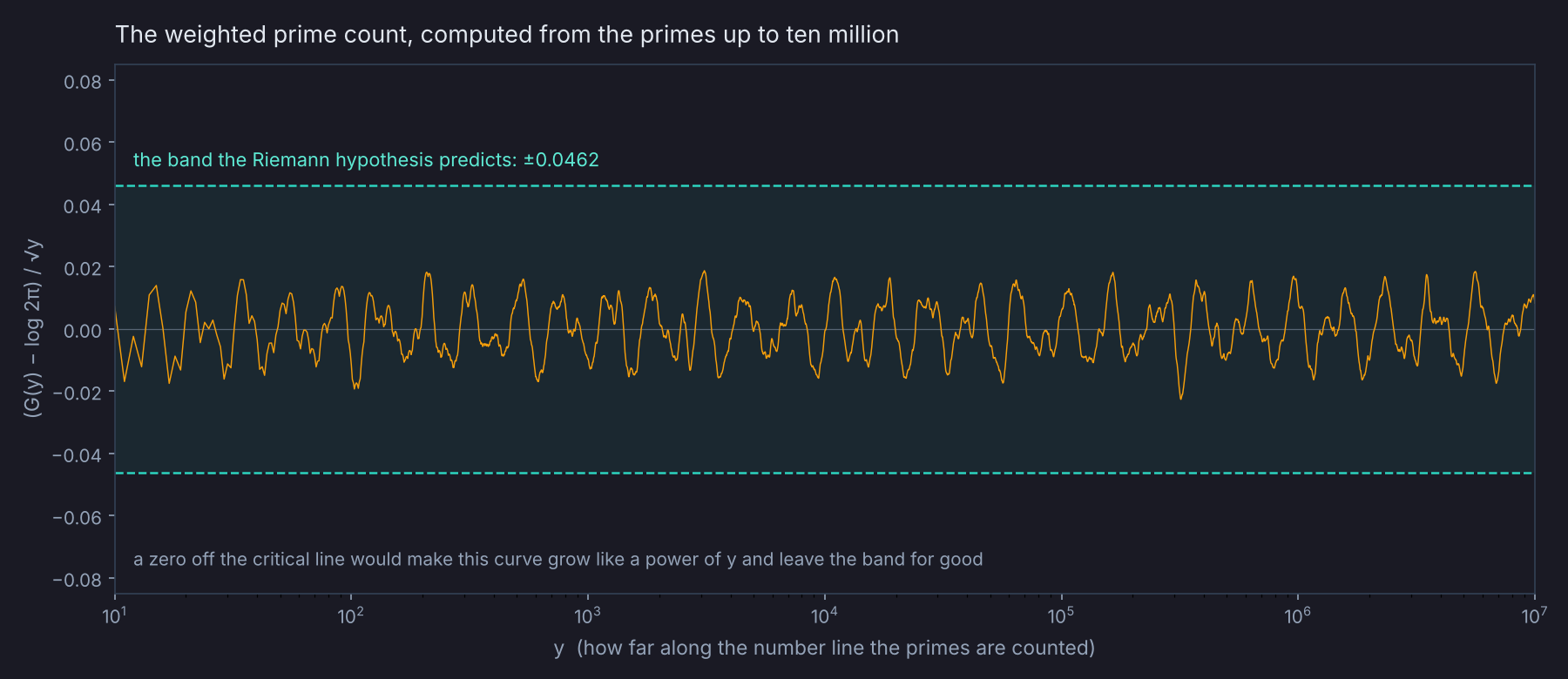
The hypothesis is the statement that this curve stays inside a band forever. And here is the first idea of the proof, a classical one sharpened: you do not need both sides of the band. A wave goes up as well as down. If you can show the count stays below the ceiling across long stretches, there is no room for a louder wave, because a louder wave would have poked through. The proof needs only this one-sided bound, and only on some long intervals, as long as the combinations involved have positive weights, so that waves from different functions cannot cancel each other out. That piece is a refinement of a theorem of Landau from 1905, and it has been machine-checked on its own, in isolation from the rest.
So the whole problem becomes: where can an upper bound on a count of primes come from?
From divisibility. Take a positive whole number N. Every prime power dividing N contributes to its size, so if you add up log p over all the prime powers that divide N, you cannot exceed log N. If you know N is divisible by a great many primes, and you can measure N’s size some other way, you have an inequality with a sum over primes on one side and a known quantity on the other. That is an upper bound on a count of primes.
This is not a new trick. It is the oldest one. In 1850 Chebyshev applied it to the factorial: a! is divisible by each prime p about a/p + a/p² + … times, and its size is given by Stirling’s formula. Out came the first proof that the number of primes up to x has the order of magnitude x/log x. The factorial is not divisible enough to give more than that. The announced proof runs the same principle with a much more divisible number. Alpöge’s timeline records the starting point, dated 9 October: a quantity built from the derivatives of a theta function on an elliptic curve with extra symmetry, which is divisible by each suitable prime p about a/p + a/p³ + … times. It behaves like a factorial that only certain primes divide, and its size can be computed exactly.
That, alone, does not give the square root. The second idea does, and it is the one Alpöge chose as the single line that would make “fellow mathematicians fall out of their chairs”.
If you only want the idea, you have it: a number divisible by many primes cannot be small, and that turns into a ceiling on how irregular the primes can be. The next two sections show where the square root comes from and what the argument rests on, with a bit more mathematics; you can skip to Who did what without losing the thread.
Where the square root comes from
The proof is a descendant of a 1969 argument for a different world, and the square root appears when you balance two costs.
The Riemann hypothesis has a twin for curves over finite fields, where the analogue of counting primes is counting the points of a curve. That twin was proved by André Weil in the 1940s with heavy machinery, and then again, starting in 1969, by Sergei Stepanov with almost none. Stepanov’s idea: build an auxiliary polynomial that vanishes at every point of the curve, and not just vanishes but vanishes to high order, a zero of multiplicity m at each point. A polynomial cannot have more zeros, counted with multiplicity, than its degree. So the number of points times m is at most the degree, and that is an upper bound on the number of points. As in the previous section, upper bounds turn out to be enough.
The obstacle to copying this for the ordinary primes is the word “multiplicity”. To make a polynomial vanish to order m you differentiate it. There is nothing to differentiate in the whole numbers. Alpöge puts it this way: multiplicity “is hard to find over the integers, corresponding to something like differentiating whole numbers”.
The substitute is divisibility, obtained by iteration. The construction that produces the highly divisible number can be chained: apply it once and you gain a certain amount of divisibility, apply it m times in a row and you gain it m times over. The technical name of each link is a theta lift, a classical way of moving a symmetric function from one group to a larger one; I will not pretend the details are intuitive. The accounting is.
Each link in the chain costs something. To bound a prime count of length x with a chain of m links, the error has two parts. One shrinks as the chain gets longer, like x/m: more multiplicity, sharper bound. The other grows with the chain, like m: every link adds its own loss. The best you can do is make them equal.
x/m equals m when m is √x, and the error is then of size √x. That is the square root of the Riemann hypothesis: the amplitude every wave is allowed to have. Alpöge’s line, in full: “for the von Mangoldt sum of length X, Claude’s suggested length of chain of theta lifts, in view of each mimicking multiplicity, was √X. (And yet, what else could it be?)”
I should be clear about what I am doing here. This is the architecture as the note and the public reading guides describe it, and I have read those; I have not verified seventeen million lines, and neither has anyone else by eye. The picture can be right and the understanding of it still be shallow. That is the state of everyone this week, the author included.
What it took underneath
The simple idea sits on top of most of modern number theory, and the archive rebuilds that too.
The route from the idea to the theorem, as the reading guides lay it out:
Two pieces of that picture deserve a sentence each. First, the divisibility is not perfect: at each link it fails by a little, and the size of the failure is measured by objects from Galois cohomology of the kind that appear in a famous unproved conjecture of Vandiver. The proof does not need that conjecture. It needs a bound on the total failure across a whole window, which it gets from Iwasawa theory; Alpöge calls it “a significant weakening of Vandiver” and adds, in a footnote, “this is still pretty strong!!”
Second, both the sizes and that cohomology are controlled by Galois representations attached to automorphic forms, the central objects of the Langlands programme and the subject of some of the deepest papers of the last thirty years. A written proof would cite those papers. A Lean proof cannot cite anything Mathlib does not contain, so the archive carries its own formal construction of them. Chris Birkbeck, a number theorist at the University of East Anglia, described what he was seeing in the community’s chat, quoted by TechCrunch: the argument “genuinely uses the existence of Galois representations attached to regular algebraic, polarized cuspidal automorphic representations of GL_n over CM fields”, along with a list of named theorems. Tao’s first impression was that it “appears to use the full power of modern developments on the Langlands program and arithmetic geometry”.
That is a large part of why the archive is the size it is. It is a proof of the Riemann hypothesis, and it is also a formalization of a good share of a research area that had never been formalized. Alpöge’s own intuition “insists it will be massively simplified, likely immediately”.
The shrinking has started, in public. A community site, riemann.verifytask.cn, keeps a running chart of attempts to make the Lean proof smaller, where a submission only counts if the result still passes verification. When I looked it showed 86 verified submissions, 26 of which had improved on the best so far, and the core of the proof 26.6% smaller than the original. The entries are signed by a person and a model: Claude Opus 5.5, several versions of Gemini 4, GPT-6. Reading the labels, most of this is housekeeping (pruning hundreds of files nothing depends on, collapsing twenty lemmas into one, inlining helpers) and not yet the conceptual simplification Alpöge is predicting. But it is people from different places, with models from three different labs, working on the same object two days after it appeared, with a machine deciding what counts.
Who did what
A mathematician who had planned his whole career around this problem set the direction, and by his own account the model outran him at the end.
The note is unusually candid about the division of labour. Alpöge writes that the problem was his secret plan since his student days, and that he spent years learning every tool he might one day recognise in it. In this attempt he “had us on the line of combining two quite different ideas present in a toy setting” and “guided us to the right situation analogous to that toy setting, and then Claude began to leave me in awe”. The decisive stretch involves automorphic forms on large groups, where he says he is “out of my element”. For those parts, he warns, his own summary paraphrases a machine summary that “might make zero sense”, and “the Lean should suffice to clarify everything”.
The timeline in the note, which he says Claude compiled, has twenty entries:
Three things the note does not say, and that I would want to know. It does not name the model; Tao describes it as “an internal AI model”, so, as with OpenAI in September, this is not something you can run. It gives no figures for compute, tokens or agents, where OpenAI published all of them for Navier–Stokes. And it is not an Anthropic announcement: it is a note on a personal website, and I have not found a company statement.
It does address the timing. Anthropic went public on Thursday 19 November; the note appeared the next morning. Alpöge writes that “the precise timing is horrible”, that the proof came together “late Sunday night”, that he messaged Dario Amodei, Anthropic’s chief executive, to ask about announcing, that “there was a constraint to respect”, and that he is “clearly unilaterally responsible for feeling I just could not live if I waited even longer”. Of the cynical reading he says only that it is false. I have no way to check any of that, and I report it as his account.
One piece of context makes the speed easier to place. In August, Anthropic reported that an unreleased version of Claude, asked by a non-mathematician on staff to “take a real stab” at the hypothesis, had raised the proven share of zeros on the critical line from 41.6% to 67.2%, and added: “We don’t expect that the techniques Claude used will lead to proving the Riemann hypothesis.” That was three months before the note.
Is this a continuation of OpenAI’s October result?
Not of the result people remember, but by the author’s own account it grew out of a quieter paper in the same release. That sentence is the whole answer; the rest of this section is the detail, and you can go straight to the other proof.
In October, OpenAI published several hundred machine-written manuscripts, which I covered at the time. One of them is The Quasi-Riemann Hypothesis: no zero of ζ, or of any Dirichlet L-function, has real part above 7/8. Until then nobody could exclude zeros from any strip at all to the left of real part 1, so this was the first real approximation to the hypothesis: the zeros are confined to a band, and the hypothesis says the band has zero width.
The natural guess is that Alpöge’s proof pushes 7/8 down to 1/2. It does not. OpenAI’s proof is an analytic one: it compares two expressions for the same sum built from a classical object called a cubic theta series, and controls the difference with estimates of the large-sieve family. That kind of argument loses a fixed amount at each step and stalls. A follow-up paper that re-optimised its parameters moved the bound from 0.875 to 0.87496.
The kinship is with a sibling manuscript in the same family, Uniform exclusion of Landau–Siegel zeros, which rules out one specific, notorious kind of zero very close to 1. Its result is weaker than the 7/8 theorem and follows from it, which is presumably why few people looked at it. Its method is the interesting part. It builds a determinant out of algebraic numbers, shows that the determinant is divisible by high powers of exactly those primes where a certain character takes the value −1, bounds its size separately, and gets a contradiction from the mismatch between the two. That is the skeleton I described above: divisibility weighed against size.
Alpöge’s note says so. OpenAI’s “quiet inclusion of the Siegel argument”, he writes, “showed great taste”, and he “immediately recognized it as Stepanov without multiplicity”. What his proof adds is the multiplicity, through the chain of lifts, and that is what turns an argument that could only exclude zeros next to 1 into one that reaches 1/2. The first entry in his timeline, “Stepanov determinant”, is dated 6 October, the day OpenAI’s repository went public.
So the honest summary is: a different idea from the celebrated 7/8 proof, and a direct descendant of a neighbouring paper that almost nobody discussed. I am reading this from the two introductions and from the note, not from an expert comparison of the proofs, and I would expect people who know this area to refine it. It is still a remarkable detail. One lab published a pile of results it described as “raw research data”, and a mathematician at the other lab found the thread that mattered in the part nobody was talking about.
The other proof, the same afternoon
Hours later, the president of the American Mathematical Society posted a human proof of the same theorem, and it is in a very different state.
Ravi Vakil, of Stanford, published a draft by Alessandro Masullo claiming the Generalized Riemann Hypothesis. “It is all human, with no AI,” he wrote; the hope had been to bring Masullo to Stanford for a year to polish the writing, and “now it seems best to put out the current draft”. Brian Conrad, a Stanford number theorist, had been giving Masullo feedback for months. Masullo’s own introduction, as TechCrunch quotes it, says the work took twelve years and carries a message for mathematicians discouraged by the current climate: “we are still here. We are very much alive. We are not going anywhere.”
The status is not comparable, and the people closest to it say so. Conrad told Scientific American that the paper is “undergoing major revision” and that judging the method requires a more final version. Within about eight hours, according to The Decoder, Vakil updated his post: several people had reported problems in the draft, found with the help of AI models, and he made “no claim as to the correctness of the proof strategy”.
Put the two side by side and you get the oddest fact of the week. One proof has been checked completely and understood by nobody. The other was written to be understood and has been checked by nobody. Until this year those two properties came together, because the only way to check a proof was to understand it.
Theorems that changed status overnight
A century of results begin with the words “assuming the Riemann hypothesis”. For the ones that need only what was proved, that clause can now be deleted.
As with Navier–Stokes, a conditional theorem does not change when its hypothesis is settled, but its meaning does. Some examples, sorted by which side of the scope they fall on.
- Now unconditional, if the proof stands. The sharpest form of the prime number theorem: for x ≥ 2657, the count of primes up to x differs from Gauss’s estimate li(x) by less than √x · log x / 8π (Schoenfeld, 1976). Robin’s inequality about sums of divisors, mentioned above. The primes in each arithmetic progression are as evenly distributed as the primes overall. Miller’s primality test from 1976, which is fast and deterministic provided GRH for Dirichlet L-functions holds, is now simply correct; in practice nothing changes, because an unconditional fast test has existed since 2002.
- Theorems that had been proved twice. Gauss conjectured that a certain count attached to quadratic number fields, the class number, grows without bound. Hecke proved it assuming GRH. In 1934 Heilbronn proved it assuming GRH is false. Between them the conjecture became a theorem with nobody knowing which proof was the valid one. We now know: Hecke’s.
- Not covered. Anything that needs the hypothesis for the zeta functions of number fields beyond the simplest kind, or for L-functions of elliptic curves and automorphic forms. Artin’s conjecture on primitive roots, which Hooley proved in 1967 under such a hypothesis, stays conditional. So do many effective results in algebraic number theory.
- Not affected at all. Cryptography. No deployed system rests on the Riemann hypothesis being false, and knowing it is true does not factor any number faster.
What mathematicians expect to matter is the method more than the list. Carlo Pagano, of Concordia University, told Scientific American it is “very plausible” that the new ideas “will open up brand new avenues of thinking in number theory”. That depends on the ideas being extracted, which brings it back to the two amber rows.
On the million dollars, the same answer as in September. The Clay Mathematics Institute requires publication in a qualifying outlet, a wait of two years, and general acceptance by the mathematical community. An archive that no one has read is, for now, none of those.
The same day, the other Millennium problem
In September I ended the Navier–Stokes article with a ladder whose top rung was empty: the unforced equations, the question most people actually mean. Tao’s note of 20 November lists, above the Riemann item and as better digested, two more announcements involving Alpöge and Tristan Buckmaster of NYU: a human-readable proof, with Matei Coiculescu, of finite-time blow-up for the unforced three-dimensional Euler equations, and a proof of finite-time blow-up for the unforced three-dimensional Navier–Stokes equations, both with Lean formalizations. Of the second, Tao says the strategy is “broadly clear” and follows an expected path, but that “more work needs to be done to create a proper, professionally written proof”. I have not read either, and they deserve their own piece. I note it here because that top rung now has a claimant, and it is the pair whose route OpenAI finished first in September.
“Math is dead”
I have read that sentence a lot this week, and I think it is the opposite of what happened. My view is that mathematics is more alive than it has ever been. Three reasons, in increasing order of importance.
The first is simply how many people are looking. A problem about the zeros of a function was front-page news, and people who had not thought about prime numbers since school spent a weekend asking what a critical line is. Even if that were the only effect, a subject that the whole world stops to watch is not a dead one.
The second is that the capacity to solve problems went up, and so did the capacity to understand them. Much of this week’s commentary takes for granted that we now have answers without understanding, and that the understanding is lost. Look at what actually happened. Within a day of the announcement there was a public map of the proof’s architecture, a guide to its seven steps and a list of which parts had been checked in isolation, all produced with AI assistance. The problems in the human draft were found by people working with AI models. The proof itself is already a quarter smaller, shrunk by volunteers and their models on a public leaderboard. The author’s plan for understanding his own proof is to work through it with the same tool that helped find it. Understanding is the part that is behind, and AI is the main reason it will not stay behind for long. I do not see how anyone digests seventeen million lines without it.
The third is what it opens. This proof connects a 1969 argument about curves over finite fields, a classical construction with theta functions, Iwasawa theory and the Langlands programme, in a combination nobody had tried, partly because trying it by hand would have cost a career. When exploring a route costs weeks, far more routes, tools and connections get explored. The questions do not run out: the wider forms of the hypothesis are still open, the proof is waiting to be simplified, and every theorem that used to say “assuming RH” is now a starting point. Alpöge, who by his own account has just lost the problem that guided his life, calls it a dawn. Sutherland calls it “a human triumph, and a day for celebration”. Masullo, with twelve years of work overtaken in an afternoon, writes “we are still here”.
What has ended is something narrower: the idea that being the first to find a proof is the main thing a mathematician is for. Choosing what is worth proving, recognising that a toy case hides the real one, and explaining why something is true were always most of the job. They are now the scarce part.
What to take from it
- What was proved is the Riemann hypothesis and its generalization to Dirichlet L-functions, in Mathlib’s own wording. The wider versions of GRH are not in the archive.
- Correct and understood have come apart. Everything a machine can check was checked within about a day, by independent people with independent tools. Nothing a referee does has been done, and no human-readable proof exists. Neither fact cancels the other.
- The central idea is old and simple. A number divisible by many primes cannot be small; Chebyshev used it in 1850. The square root comes from balancing the length of a chain against the cost of each link.
- The idea is simple; what holds it up is not. It rests on a formal reconstruction of a large part of the Langlands programme, which is where most of the seventeen million lines go.
- A human chose the route and the model finished it. That is the author’s own description. He also says he cannot yet explain the last stretch, and that understanding it is the work that starts now.
- The model is not one you can use, and the numbers behind the run are not public.
- Mathematics is not dead. More people are watching it than ever, the tools that found the proof are the ones that will explain it, and far more routes can now be explored.
For anyone building with agents, the part of this that transfers is not the mathematics. It is that the result was accepted in a day because a small, independent, well-understood checker existed, and because the statement to be checked had been written down by someone else beforehand. Where your work has both of those, you can let a model run a long way ahead of you. Where it has neither, the 250,000 pages are all you get.
Sources: Alpöge’s announcement; Andrew Sutherland’s verification files at MIT; the Lean community’s verification repository; the independent map and guide to the proof; Terence Tao’s note; Scientific American on the announcement and on the two claims; TechCrunch’s report; and Anthropic’s August post on Claude and the zeros of the zeta function.