A World Model Can Pass Every Test and Still Lose
In this article
A while back I wrote that programming is drifting from verifying how code works to verifying what it produces — results-oriented programming. This post is what happened when I took that idea seriously enough to break it. I set out to reproduce a DeepMind result and instead spent a few weeks on a small, stubborn question: if a result-check passes, does that actually mean the result is right? The answer, it turns out, is “not necessarily” — and you can say exactly when it fails, and prove part of why.
I wrote the whole thing up as a preprint, When a Verified World Model Still Loses: Play-Adequacy vs Prediction-Accuracy in LLM-Synthesized Code World Models, now on arXiv (arXiv:2607.14169). The code and full reproduction log are open; the rest of this post is the story in plain language.
The setup: Code World Models
The paradigm I was poking at comes from DeepMind’s Code World Models for General Game Playing (Lehrach et al., 2025). Instead of asking a large language model to play a game directly, you ask it to write the game’s rules as a Python program — a “world model” with functions for legal moves, transitions, and outcomes. Then a classical planner (Monte Carlo Tree Search) plays against that synthesized program. The division of labour is elegant: the LLM does translation (rules → code), classical search does the looking-ahead.
It works well, and on known games a small model + MCTS beats the same model used as a direct policy by wide margins. I reproduced that. But one step bothered me: the verification step.
Before the planner trusts the synthesized world model, the model is refined until it reaches 100% transition accuracy on a batch of random play-throughs — predicted next-state, legal moves, outcome, all matching the true game. Pass that and you “pass the gate.” It looks like a clean, automatic correctness check.
The question I couldn’t shake: passing that gate means the model matches the truth on random play. Does it mean the model is good enough to plan with?
The honest null
The first thing I’ll say is the boring, important part: on small, fully-specified games, the gate is enough. Tic-tac-toe, a generalized-chess variant (army5x5a, below), Trike — whenever a synthesized model passed the gate, it was also correct on the states the planner actually visits. No gap. I report that as a null result, because it sets the boundary: the gate is a strong filter when the rules are complete and the state space is small.
So the interesting question becomes: when can the gate be fooled? And the condition is precise: you need a rule that random play almost never triggers but competent play reliably seeks out.
The instrument: a rare rule that decides games
To make that condition real I didn’t invent a game from scratch — I took a small generalized-chess game from that same DeepMind paper (army5x5a, defined in its Appendix H.5: a 5×5 board with general, infantry, and cavalry pieces, won by capturing the enemy general) and added one rule: if the game reaches a long move cap with both generals still alive, the player with more material wins instead of drawing. Under random play, that rule decides the game about 2.5% of the time — random games end early, by blunder. Under competent play it decides roughly half of all games, because good play survives to the cap.
Now omit that rule from the spec and synthesize a world model. The result is a model that:
- passes the gate at 100% transition accuracy,
- is ≥98% accurate on the exact distribution of states the planner visits,
- and yet loses systematically at play (win rate 0.404 vs 0.495 for a calibrated fair baseline — a play cost of 0.091, with non-overlapping 95% confidence intervals; seed-clustered 95% CI [0.065, 0.117] over 20 seeds).
Throughout, play cost is just the win rate the flaw gives up: the fair baseline’s win rate minus the flawed model’s, both playing the true game at the same budget. 0 means “plays as well as the truth”; bigger means “the flaw is costing you games.”
The handful of states it gets wrong are exactly the ones that decide games. Averages hide it — the error is diluted away by all the ordinary positions it gets right. Prediction accuracy and play-adequacy come apart, cleanly and reproducibly.
To be sure this wasn’t an artifact of my hand-written stand-in, I also ran it end-to-end through the actual synthesis pipeline, at the same budget and with its own confidence intervals: the synthesized model passes the gate only when the rare rule happens to be absent from its sample, and when it does, it loses at play — with a cost at least as large as the one above. Same effect, no human in the loop drawing the flawed model by hand.
| Arm (vs the true game) | Win rate [95% CI] | Play cost |
|---|---|---|
| ● Fair baseline (truth vs truth) | 0.495 [0.475, 0.515] | — |
| ● Rule-blind instrument (Panel A) | 0.404 [0.384, 0.424] | 0.091 |
| ● Synthesized, rule-absent (Panel B) | 0.345 [0.317, 0.374] | 0.154 |
Play cost is measured paired-by-seed against each arm's own fair baseline; the synthesized arm's larger cost reflects imperfections beyond the omitted rule. Full numbers and CIs in the preprint.
A law for when verification goes blind
The nice part is that this isn’t a one-off anecdote; it has a shape. The expected harm follows
where rarity is how often a random play-through triggers the omitted rule and is how many play-throughs the gate samples. The factor is exact — it’s just the probability that independent random games all miss the rule. So harm is negligible while the rule is common enough to get caught, rises through a threshold as it gets rarer, and saturates at the full cost of the rule once it almost always escapes the gate.
There’s a sharper way to read that factor. When the rule never shows up in the sample, the data is literally identical whether the rule is in the model or not. So no learner of any kind — not a bigger LLM, not gradient descent, not exhaustive search — can recover the rule from that sample alone. It isn’t a model weakness; it’s missing information. Any recovery has to come from the specification, not the data.
Translation, not inference
That leads to the finding I find most practical. Can you repair the gap by feeding the model examples of the rule? I tried — properly: DAgger, on-manifold harvested states, dozens of discriminating examples, two model sizes, refinement loops that draw fresh data every iteration.
(For the imitation-learning fans: “proper DAgger” here means the Ross et al. (2011) loop — collect states from the current flawed model’s own play and relabel them with the oracle — not just dumping competent trajectories.)
It doesn’t work. Across the board, the synthesized model stays rule-blind even when the rule is present in its training trajectories with near-certainty (you can watch it: the gate accuracy sits far below 1.0, meaning the rule is in the data, and after six refinement passes the model still hasn’t encoded it). The behaviour is rule translation, not rule inference: the model faithfully encodes rules it is told, and does not reliably infer rules it is only shown. The actionable version: complete the specification before you synthesize. Verifying on the play distribution will detect an incomplete spec; it will not repair it.
The same split on the belief side
Games with hidden information — poker and the like — add a second thing the model has to get right: not just the dynamics, but a belief function, the code that reconstructs what a player can’t see from what they can. I expected the gap to show up here too. The first surprise was that it doesn’t — and the reason is almost funny.
On small poker games (Kuhn, Leduc) the sampling gate is provably enough to certify the belief function; one can write the bound down. Random play turns out to be a more thorough explorer of a betting tree than skilled play, because it raises and calls indiscriminately while good play folds and bails. So the rare belief-states never hide from the gate — competent play only ever visits a subset of what random already covered. No gap.
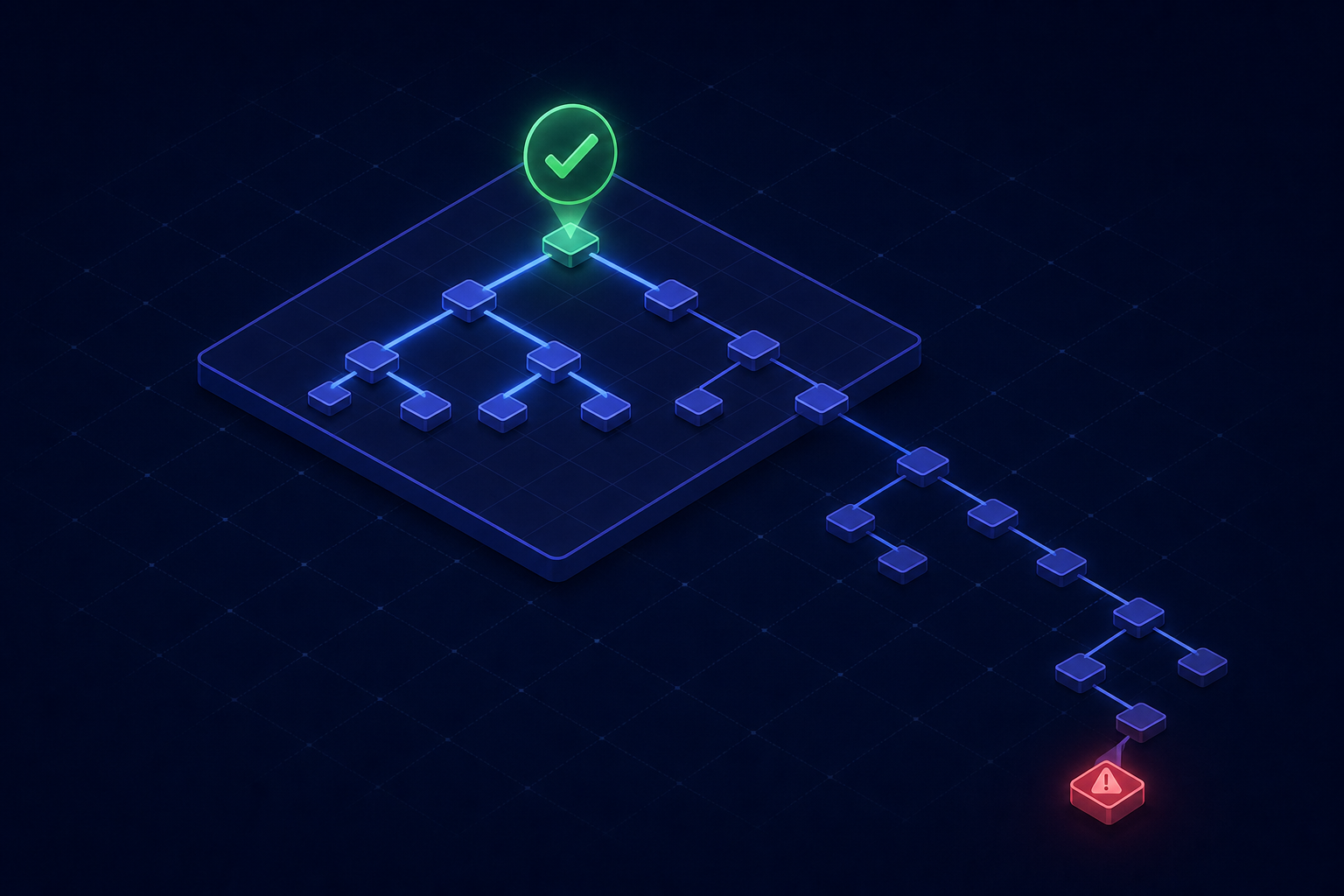
But that tells you exactly what a gap would need: a game where skill takes you deeper than randomness — where depth comes from surviving, not from flailing. So I built the smallest game I could that has that shape. Call it Beacon, and it’s essentially the picture you’d draw on a napkin: a walk where, at each step, you pick a move — one choice lets you continue, the wrong one ends the game on the spot. Random play wanders off the path almost immediately; skilled play walks all the way to the end. And at the very end there’s a single decision that turns on a hidden fact about your opponent — a fact you could have read from the moves they made on the way down.
Now hand a model a belief function that is correct everywhere except that final stretch — the deep end of the walk that only skilled play ever reaches. It sails through the gate (random play never gets far enough to test it) and then loses every single game, because the one place its beliefs are wrong is the one place the game is actually decided. Same shape as the rare rule, now on the belief side: verified, and still wrong exactly where it counts.
To be upfront: Beacon is a deliberately constructed witness, not something a model stumbled into — an existence proof. And the deep placement isn’t a trick, it’s the whole point: it’s the only spot that is simultaneously unreachable by the gate (which samples shallow, random play) and decisive for the outcome (the game is settled in the final round). Put the error anywhere shallower and the gate catches it; make it somewhere that doesn’t decide games and it costs nothing. “Wrong exactly where the gate can’t look and the game is won” is precisely the corner the construction has to hit — and Beacon proves that corner is non-empty.
There’s a clean structural point underneath: a transition-accuracy gate is blind by construction to the belief function. What a player can and cannot see never appears in a “this state became that state” transition — so no amount of transition-checking can catch a wrong belief model; you need a separate check on the beliefs themselves. (These imperfect-information results use games I instrumented by hand to isolate the effect, rather than fully synthesized models — a distinction I’m careful to keep in the paper.)
The more hopeful half of the story is that this separate check is often enough, and provably so. In the paper I work out a coverage bound: a random inference gate is guaranteed to catch belief errors once it samples more than roughly bᵈ play-throughs, where b is how many choices a player faces at each step and d is how deep the game’s decisions reach. Shallow games clear that bar easily — which is exactly why Kuhn and Leduc poker show no belief gap at all; their gate is provably sufficient. For games too large to enumerate, there’s a companion bound that caps the undetected error a gate-passing belief function can hide. Beacon is simply the case engineered to sit on the wrong side of that bound. What’s still missing — and what I’d flag as future work — is an adversarial belief check that deliberately samples the deep, skill-reachable region instead of hoping random play wanders in; that’s the check that would actually close the Beacon-shaped hole.
What I actually take from this
A passing test suite — or a sampling-based gate — is a result-check with a coverage blind spot. It certifies the model exactly where your samples land, and competent behaviour systematically lands somewhere else: the rare, pivotal, deep parts of the space. If you verify a world model (or, honestly, any model used for planning or decisions) by sampling, measure adequacy on the distribution it will actually be used on, not on a convenient random one. And when correctness depends on a rule, put the rule in the spec — don’t hope the system infers it.
If you want the formal version, with the theorems and the numbers, it’s in the preprint. The code is open too.
Preprint: “When a Verified World Model Still Loses” (arXiv:2607.14169) · code. Related reading: Results-Oriented Programming and Software Dissolving Into the Model.