Where's the Ball? Testing Whether a VLM Has a Spectator's Intuition
In this article
Watch a football match from the top row of the stadium, where the ball is a barely-visible speck, and something curious happens: you usually know where it is anyway. The players tell you. Bodies lean, a cluster forms, everyone starts drifting the same way — and your eye lands on the ball a beat before you actually see it. It’s not tracking. It’s a kind of social inference: you know the game, so the people tell you about the thing.
I wanted to know whether a generalist vision-language model has that same intuition. Not a specialist tracker trained on ball trajectories — those exist and they’re good (Maksai et al., Kim et al. 2023, TranSPORTmer all infer the ball from player motion). I mean a model that “knows the game” the way a person in the stands does, and has never been trained for this task specifically. Can it look at a frame with the ball erased and point to where it must be?
The honest answer turned out to be yes, a little, and only the biggest models — but getting to an answer I actually trust was most of the work, and it’s the part worth writing about.
The setup
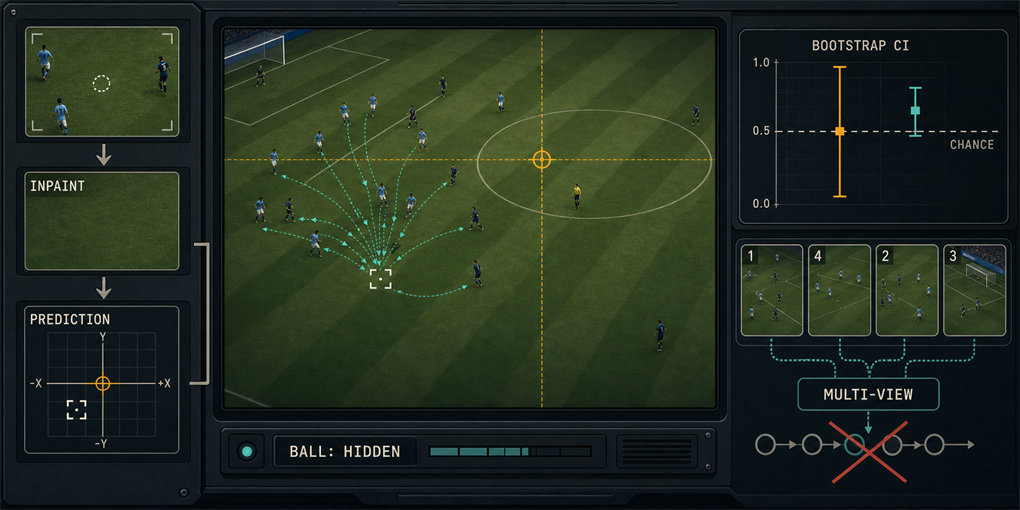
I used SoccerNet-Tracking: broadcast clips with per-frame bounding boxes for every player and the ball. For each frame I removed the ball with LaMa inpainting — deep inpainting that reconstructs a coherent patch of grass, line, or shirt where the ball was, so the model can’t cheat by spotting an editing smudge. (Classical inpainting left tell-tale blurs on pitch lines; a leak-control step with a VLM confirmed the deep version leaves nothing to latch onto.) Then I asked several models for the ball’s coordinates and scored the distance to the truth.
The models: GPT-5.4, Claude Opus 4.8, Claude Sonnet 4.6 (all via API), and Qwen2.5-VL-7B as an open-source reference, run on a GPU. Against them, two dumb baselines: “the ball is at the center of the frame” and “the ball is at the centroid of the players.”
The trap I walked straight into
My first run looked great. GPT beat the center baseline; on the hardest cases — balls far from the middle of the frame — it seemed to win 64% of the time. Tidy story: generalist AI has spectator intuition. I could have written that article.
Two problems, both mine.
First, a confound. Broadcast cameras follow the ball — they keep it near the center of the shot. So “just guess the center” isn’t a dumb baseline at all; it’s a strong one, and any model that leans central looks smart for the wrong reason. Second, and worse: my sample was tiny. That 64% came from 14 items. When I put a bootstrap confidence interval around it, the interval ran from 36% to 86% — comfortably including 50%, i.e. chance.
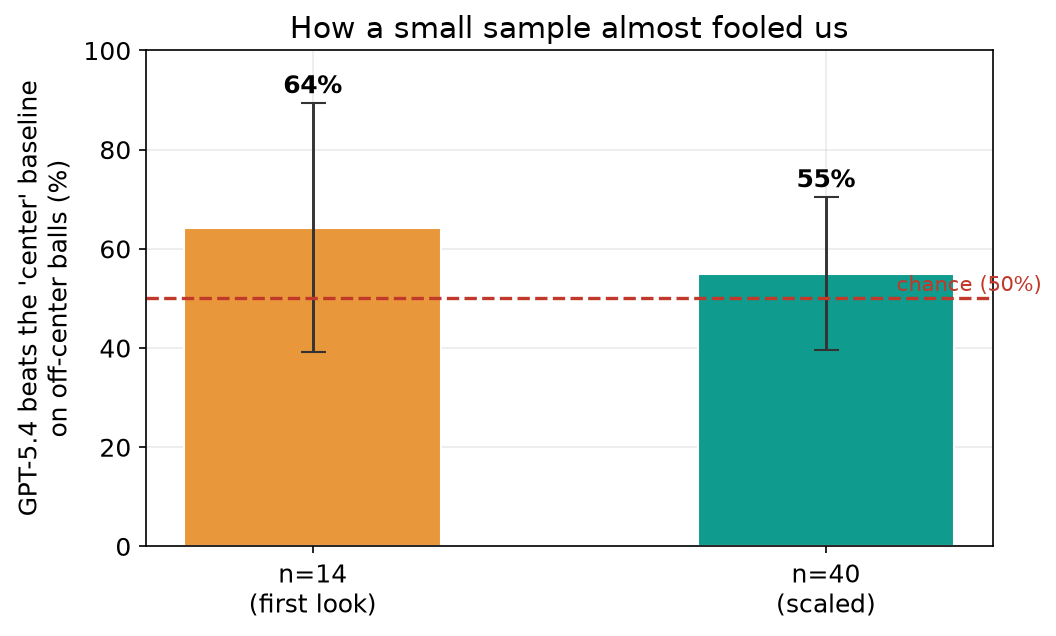
So I rebuilt the test to defuse both issues: I balanced the dataset by the ball’s distance from the center (so “guess the center” is useless by construction), and I scaled up. At a larger sample the same off-center win-rate settled at 55%, and its interval still touched 50%. The exciting first result hadn’t survived contact with statistics. It was a mirage made of a followed camera and fourteen data points.
I mention this not to be self-deprecating but because it’s the whole point: a confounded baseline plus a small sample will hand you a satisfying, publishable, wrong conclusion, and it will feel true. The only defense is boring — de-bias, scale, bootstrap, and try to break your own finding before you believe it.
What’s actually true
Once the sample was honest, I stopped leaning on error-on-a-hard-subset (still underpowered) and used a better-behaved measure: does the model’s prediction correlate with where the ball actually is, across the whole range of positions? That question the data can answer.
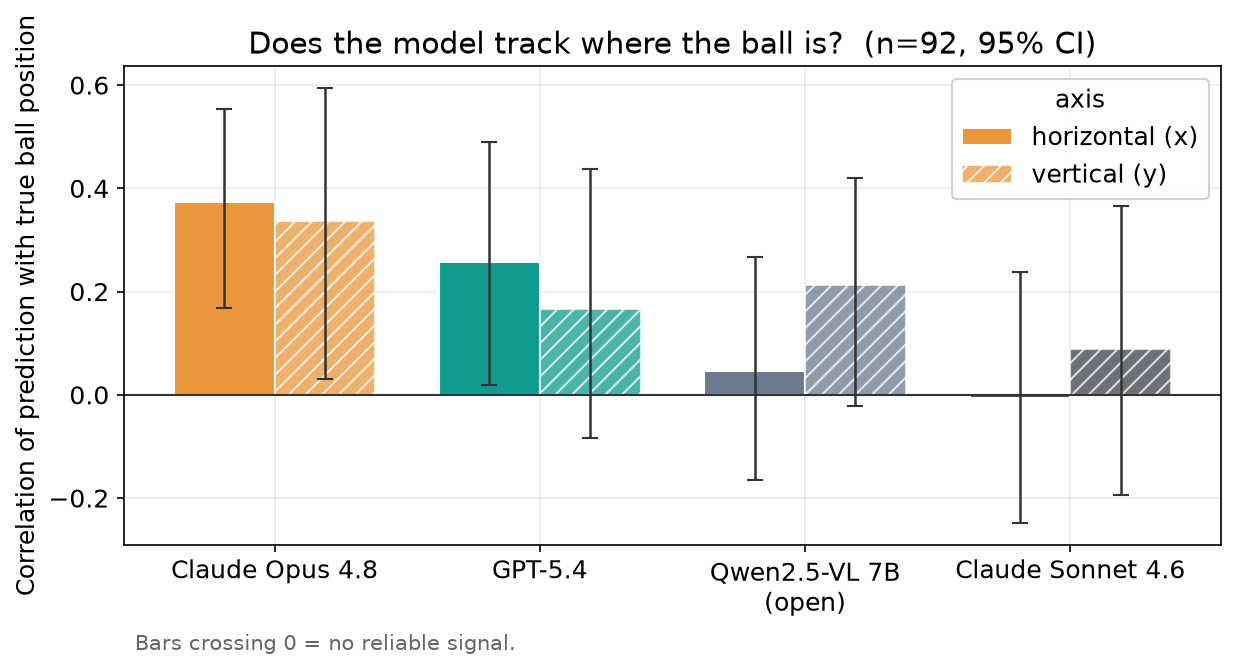
- Claude Opus 4.8 has the clearest signal — its guesses track the true ball position on both axes, and the confidence intervals stay clear of zero.
- GPT-5.4 shows partial signal (solid horizontally, noisier vertically).
- Qwen2.5-VL-7B (open) and Claude Sonnet 4.6 are, statistically, flat — their intervals straddle zero. They aren’t pointing at the center out of laziness (I checked — their predictions are spread out); they’re just not tracking the ball.
So the spectator intuition is real, but faint, and it’s a frontier-model trait: it shows up in the big closed models and not in the smaller open one or the mid-tier Claude. And a sober caveat that survived all the scaling: from a single frame, no model reliably beats the center bias on genuinely off-center balls. The intuition is there in aggregate; it isn’t strong enough to nail the hard, wide cases from one still image.
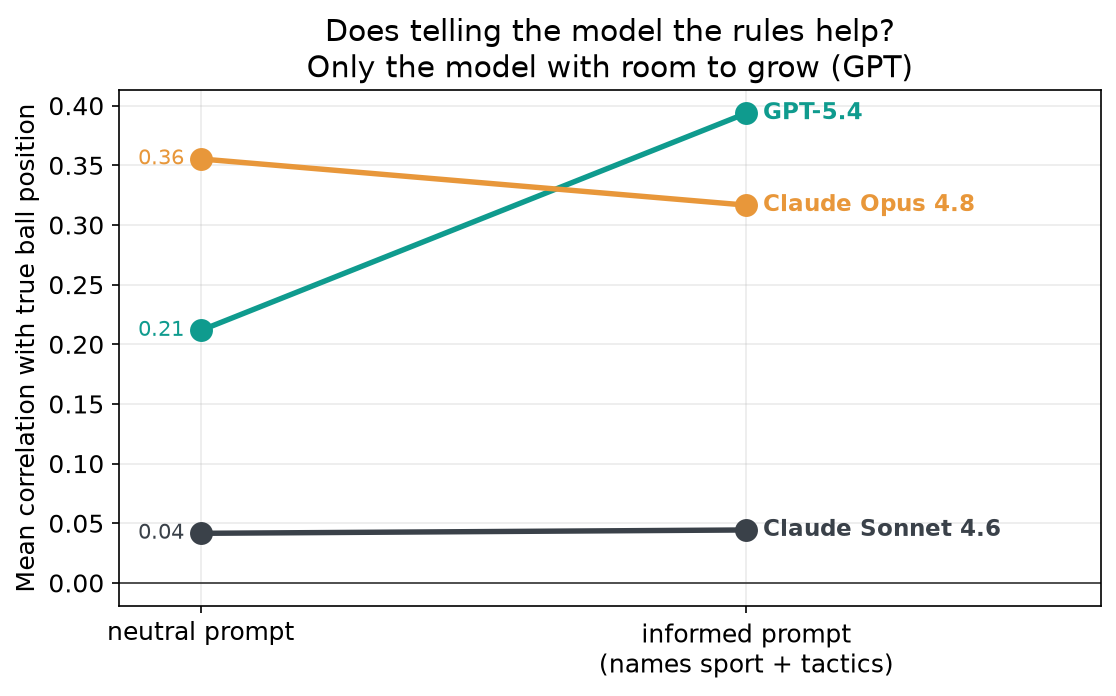
One more twist, which I liked. I gave every model an “informed” prompt — naming the sport and spelling out what a spectator uses (players orient toward the ball, converge on it, the carrier leads a cluster). It helped GPT a lot (its correlation jumped), did nothing for Sonnet, and barely moved Opus. Read that carefully: Sonnet’s problem was never that it didn’t know football. Telling it the rules changed nothing, because its bottleneck is seeing, not knowing. For GPT, which could already reason about the scene, the framing unlocked headroom — the prompt mattered about as much as the model tier.
The video that wasn’t about video
Here’s where I was sure I knew the answer in advance. A single frame is ambiguous; a spectator’s real trick is watching the play develop. So I gave the models short sequences — four frames spanning a few seconds, the ball erased from all of them — expecting the motion to unlock the hard cases.
It did seem to help GPT. But before believing it, I ran the control that matters: I shuffled the frames into a random order. If a model reads motion, scrambling time should destroy the benefit.
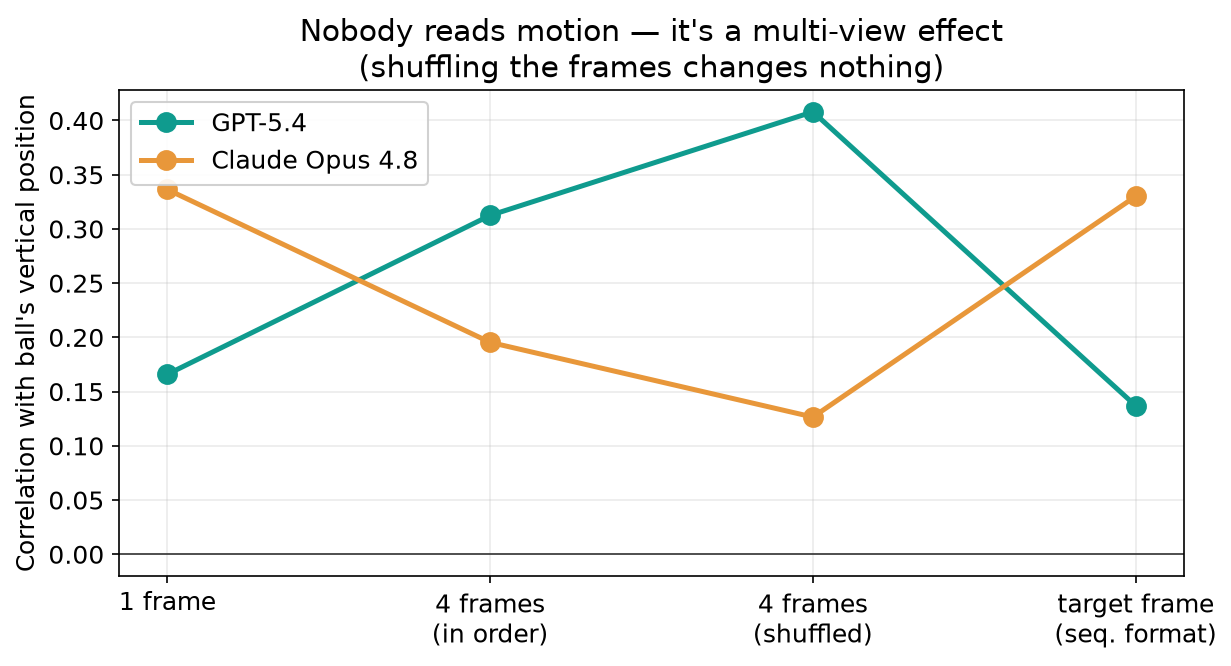
Shuffling changed nothing. The order of the frames was the single cleanest null in the whole experiment. No model is integrating the trajectory of the play — they aren’t reasoning about motion at all. What actually changed with multiple frames was something duller and stranger: extra views of the scene, in any order. And the two frontier models handle that in opposite ways. GPT aggregates — more looks at the moment, even scrambled, sharpen its guess. Opus gets diluted — the extra frames pull it away from a target-frame read it was already better at. The best single-frame model was the worst at using more frames.
That’s a more interesting finding than “video helps,” and I’d have missed it if I’d trusted the first, flattering version.
Takeaways
- Generalist VLMs do have a faint spectator’s intuition — their guesses correlate with the hidden ball — but it’s a frontier-model trait (Opus clearest, GPT partial) and it’s weak: a single frame doesn’t crack the genuinely hard cases.
- They don’t reason about motion. What looks like temporal understanding is really multi-view aggregation, and models differ in whether extra views help or hurt.
- Knowledge isn’t the bottleneck; seeing is. Explaining the game helped the model that could already reason visually and did nothing for the one that couldn’t.
- The methodology was the hard part. A followed camera and a small sample produced a clean, wrong story that felt right. De-biasing, scaling, bootstrapping, and adversarially auditing my own results changed the conclusion twice.
There’s a Level 2 waiting — other sports, whether the skill transfers, and the geometry underneath it all — but that’s for later. For now the honest headline is smaller and better than the one I almost wrote: the model in the stands can feel where the ball is, a little, if it’s big enough; it just can’t watch the play to find it.
Code, data pipeline, and the full audit (bootstrap CIs and all) are in the wheres-the-ball repo. Built on SoccerNet-Tracking; ball removed with LaMa via IOPaint. Prior specialist work worth reading: Maksai et al., Kim et al. 2023, TranSPORTmer.