They are already building
Nobody approved it — it just happened, because the tools got good. The risk is already there whether or not anyone is tracking it, and the people carrying it don't know which questions to ask.
They are wiring tools to your real data without knowing which questions to ask. In one day I teach them the questions that matter — using the project they are actually building.
People in product, operations, marketing and finance are building their own tools now. They describe what they want, an agent builds it, and it works. That part is real.
The problem isn't code quality — the agent writes decent code. It's that nobody ever told them which categories of risk exist: that having a login is not the same as being protected, that a key stays in the project's history after you delete it from the code, that by default nothing caps the bill.
You cannot ask about a space you don't know is there. An agent answers any question well — what it won't do is tell you which question you should have asked.
Your engineers can't review everything the rest of the company builds. Usually they're just the ones who inherit it.
Nobody approved it — it just happened, because the tools got good. The risk is already there whether or not anyone is tracking it, and the people carrying it don't know which questions to ask.
Then the choice isn't between letting them build and stopping them. Teams pick these tools up with or without permission. The real choice is whether it happens deliberately, with the guardrails explained up front, or quietly. Teaching first costs a fraction of correcting later.
You bought the licences, everyone has access, and the team moves at exactly the speed it did before. That's the normal outcome, not a botched rollout: a small group uses it daily and gets a lot out of it, some use it occasionally and badly, and a large share never opened it. Licences are adoption. Adoption isn't skill, and only one of the two shows up in the dashboard. And there's a duller cause almost nobody checks: the tool isn't connected to anything of yours, so the person becomes the cable — copy, paste, then carry the answer back by hand to wherever the work actually lives. That costs the same every time, which is why people stop.
Whichever one you're in, what the team needs is the same — and it isn't a programming course. It's knowing which questions to ask, so you can hand them the tools without handing them the risk.
The whole thing is published. Read it and judge it before you talk to me.
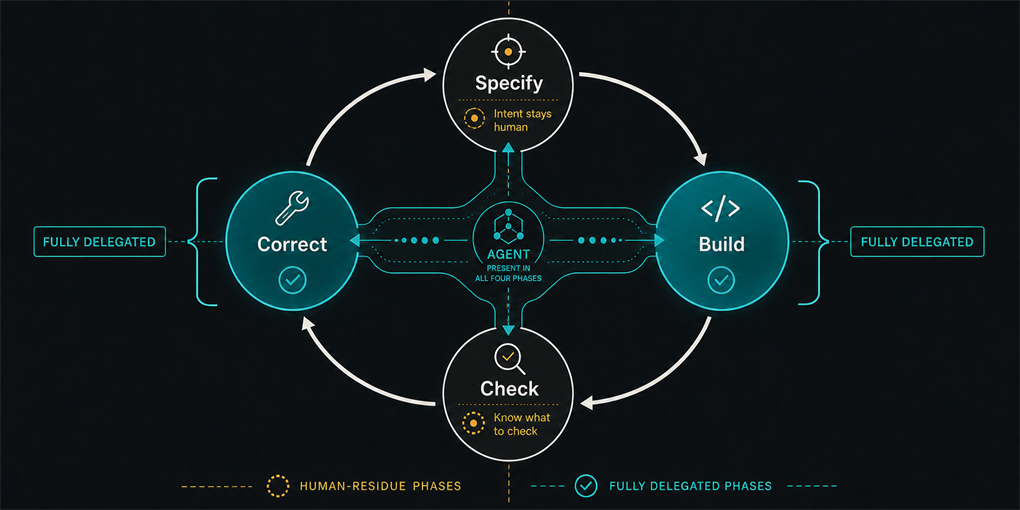
Specify, build, check, correct. Two of those four phases hand over to the agent completely — and they are exactly the two people mean when they say "programming". What is left is saying what you want and knowing whether you got it.
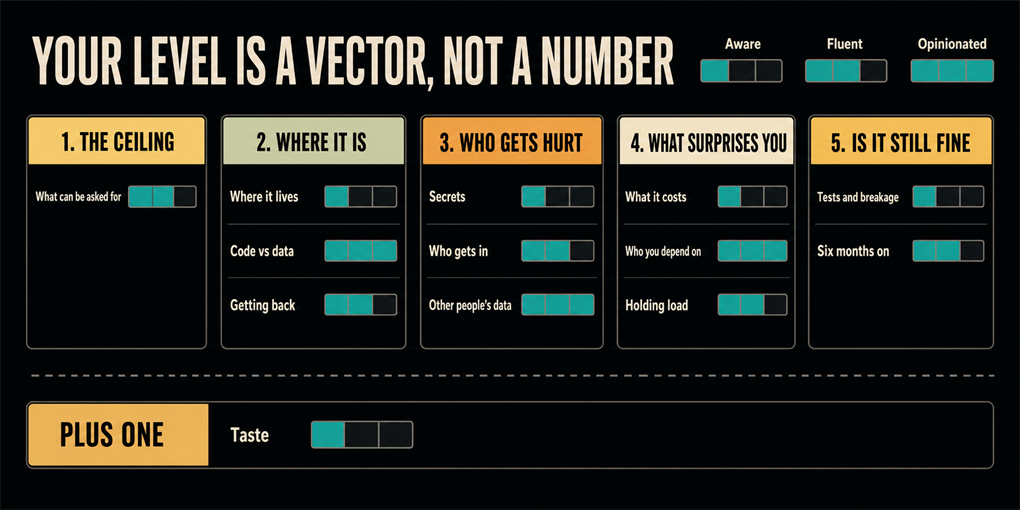
Twelve categories where things go wrong, plus one of taste. For each one, three levels: knowing it exists, being able to ask about it, and having a view of your own. Nobody sits on the same level across the board — the profile comes out jagged, and that is exactly what the diagnosis measures.
Prices are a starting point, not a tariff. Sessions run online, which is usually better anyway.
For the people who haven't started. Everyone brings one task from their own week — nothing technical — and leaves having done it themselves. No frameworks, no security, no production.
The point isn't that they understand it. It's that they've done one useful thing before the hour is up.
We go through your own project. You leave knowing where your gaps are and which one to close first.
For anyone building alone — changing careers, starting something, or just checking whether this applies to them.
A working session with the people who are already building. You leave with the map of your own project: which boxes are empty, who covers each one, and what to cover first.
A diagnosis, not a course. The first workshop is half price in exchange for a testimonial.
Regular sessions while the team builds for real, reviewing their actual work rather than examples.
Usually decided after a workshop, once you know whether it is worth it.
See exactly what happens during the day →
In Spain, in-company training is FUNDAE-eligible, which can cover most or all of the cost. Ask me and we will look at it.
A short call is enough to tell whether this helps you or not. If it does not, I will say so.
Book a call